- Ten minutes loosens your whole body. Ten seated stretches cover the hamstrings, hips, spine, neck, chest, ankles and wrists; a four-move version takes two. No floor, mat or balance needed.
- The dose is easy. Holds of 10 to 30 seconds, about 60 seconds in total per stretch, on at least two days a week [1][2]. After 65, gentler holds of 30 to 60 seconds work better [3][2].
- Desk aches drop. Office workers with neck, shoulder and low back pain who stretched for 10 to 15 minutes three times a week had significantly lower pain scores in all three areas, and were still improving between months four and six [4].
- On a long journey, keep your calves pumping. Over four hours, calf pumps and a walk down the aisle are the health advice against blood clots [5][6].
- Finish on your feet: a half-lunge, a wall calf stretch and five slow sit-to-stands.
- FlexBuddy® takes it further: the full straight-spine hamstring and calf stretch at home, in two minutes.
You can stretch most of your body without leaving your seat, and you will feel the difference the moment you stand up. Below: a ten-stretch seated routine with hold times, a two-minute version, and versions for a plane seat, a car and older adults, with the studies behind them.
Who chair stretches are for, and what they do for you
Four groups get the most from a seated routine: office workers, because the chair is already there; travellers, because a seat is all the space there is; people with balance concerns, because sitting takes balance out of the equation; and anyone on a recovery day.
The proof comes from people who sit for a living. In a randomised trial in Malaysia, office workers aged 20 to 50 with neck, shoulder and low back pain did thirteen stretches, 10 to 15 minutes a session, three times a week. Their pain scores in the neck, both shoulders and the lower back came out significantly lower than in an untreated group over six months. Adjusting desks and chairs helped too, but only the stretchers were still improving between months four and six [4].
That is 10 to 15 minutes, three times a week, and you will feel the first change the moment you stand up after the routine below.
Chair safety: set up before you stretch
The NHS advice for seated exercise is short: choose a solid, stable chair without wheels, sit with your feet flat on the floor and your knees bent at right angles, and avoid chairs with arms, which restrict your movement [7]. If an office chair is all you have, lock the castors or push it back against a wall, and lower the seat until both feet are flat.
Then sit forward. Most of these stretches start on the front half of the seat, upright and away from the backrest [7], so that the pelvis is free to tip, but far enough back that the chair cannot tilt. Stretch to mild tightness, never pain, and breathe slowly. If a stretch brings on sharp pain, pain that travels down an arm or a leg, numbness, tingling or dizziness, stop and get advice.
The 10-stretch seated routine
The American College of Sports Medicine recommends flexibility exercises for each major muscle group totalling 60 seconds per exercise, on at least two days a week [1]. A review of the stretching research adds that 10 to 30 seconds per hold is enough for most adults, and that two to four repetitions are all a muscle needs [2]. The times add up to ten minutes.
| # | Stretch | How | Hold and reps | Time |
|---|---|---|---|---|
| 1 | Seated hamstring hinge | One leg straight, heel down; long spine, tip forward from the hips | 30 s, twice per leg | 2:00 |
| 2 | Seated figure-4 | Ankle on the opposite knee; sit tall, lean forward | 30 s, twice per side | 2:00 |
| 3 | Seated spinal twist | Arms crossed; turn the ribcage, hips still | 15 s, twice per side | 1:00 |
| 4 | Seated cat-cow | Hands on knees; arch and lift the chest, then round gently | 8 slow reps | 0:40 |
| 5 | Side bend | One hand on the seat, other arm overhead; lean away | 20 s per side | 0:40 |
| 6 | Neck side bend | One hand on the seat; ear towards the opposite shoulder | 15 s, twice per side | 1:00 |
| 7 | Chin tuck | Draw the chin straight back, eyes level | 5 s, 6 times | 0:30 |
| 8 | Chest opener | Hands behind the head, elbows wide, or clasped behind the back; or the FlexBuddy Shoulder Opener | 15 s, twice | 0:30 |
| 9 | Ankle circles and calf pumps | Circle each foot; then raise the heels, then the toes | 5 circles each way, 20 pumps | 0:40 |
| 10 | Wrist and forearm stretch | Arm straight; draw the fingers back, palm up, then palm down | 15 s each way, each arm | 1:00 |
1. Seated hamstring hinge
The hamstrings run down the back of the thigh from the sitting bone to just below the knee [8]. At the front of the seat, straighten one leg, heel down, toes up. Hands on the bent thigh, lift your breastbone and tip forward from the hips until the back of the thigh pulls. If you feel it in your lower back, you have rounded: sit up and start again. At home, do the two-leg version on the floor with FlexBuddy: the strap carries the reach and your spine stays long.
2. Seated figure-4
Rest one ankle on the opposite knee and let the raised knee drop as far as it wants to. Sit tall, then lean forward from the hips until the outer hip and buttock pull. Skip it if the knee itself hurts. The lying versions are in the piriformis stretch guide.
3. Seated spinal twist
Cross your arms, hands on your shoulders, and turn your upper body without moving your hips, which is how the NHS teaches it [7]. On a swivel chair, plant both feet so that your ribcage turns and the seat does not.
4. Seated cat-cow
Breathe in, tip the pelvis forward and lift the chest; breathe out, tip it back and round gently. Keep it moving and unhurried: a spine that has kept one shape for hours loves it.
5. Side bend
Hold the seat with one hand, reach the other arm up and lean away from it, both sitting bones down.
6. Neck side bend
Hold the seat with your right hand to keep that shoulder down, then tilt your left ear towards your left shoulder; the NHS version anchors the shoulder with the opposite hand instead [9]. Never pull on the head. More options are in the neck stretches guide.
7. Chin tuck
Look straight ahead and draw your chin straight back, as if making a double chin, without tipping the head: the opposite of the head-forward position a screen invites.
8. Chest opener
Hands behind your head, elbows wide, breastbone lifted. If your shoulders dislike that, clasp your hands behind your back and draw them down. The gentlest version, from the NHS: shoulders back and down, arms out to the sides, chest forward and up [7]. With FlexBuddy in your desk drawer, swap in its Shoulder Opener: sit tall, hold both handles with straight arms, raise it overhead and slightly behind you, lower with control, 5 to 8 slow reps.
9. Ankle circles and calf pumps
Straighten one leg and circle the foot both ways, or point the toes away and then back towards you, a movement the NHS says improves ankle flexibility and lowers the risk of a blood clot [7]. Then, feet flat, raise both heels, lower them and lift the toes. The calf is the pump that sends blood back up the leg. In one study, six hours of unbroken sitting cut the lower leg's blood-flow response by 43%, and a ten-minute walk restored it [10]. Shoes off, roll the FlexBuddy foot bar under each sole for a foot massage while you work.
10. Wrist and forearm stretch
Hold one arm straight out, palm up, and draw the fingers down and back with the other hand until the inner forearm pulls. Repeat with the palm down.
The 2-minute version and the 10-minute version
Two minutes, between tasks. Hamstring hinge, 20 seconds per leg. Figure-4, 20 seconds per side. Chest opener, 20 seconds. Twenty calf pumps. In a trial that more than halved new low back pain in office workers, the stretching part was a single 30-second hold, done twice each working day at 10 a.m. and 2 p.m. [11]. Mid-morning and mid-afternoon is the pattern to copy.
Ten minutes, once a day. Work down the table in order, at lunchtime or when you close the laptop. Three sessions a week matches the dose in the office trial [4], and daily is fine because nothing here is strenuous. Give it a week and you will not want to skip it. At home, the two-minute daily routine is its floor-based partner, and it is where FlexBuddy comes in.
Stretches on a plane or in a car
An economy seat has room for more than you think: the ankle, neck and wrist stretches, the chin tuck and a small twist all fit, and so does the figure-4 in an aisle seat. The hamstring hinge waits until you land, and FlexBuddy fits in a backpack for the full version at the hotel.
The real reason to move on a long flight
The NHS lists a journey of more than four hours by plane, car or train as a time when deep vein thrombosis (DVT), a blood clot in a vein, usually in the leg, is more likely [5]. For a healthy traveller the risk is small. Among employees of international organisations there was one symptomatic clot for every 4,656 flights of four hours or more, about three times the rate in those who had not flown [12]. Risk is higher over 60, in smokers, after a previous DVT, in pregnancy and on the combined pill or HRT [5].
The answer is simple: move. The NHS advice is loose clothing, plenty of water, no alcohol and walking around when possible [5]. The US Centers for Disease Control and Prevention adds seat exercises: work the calf muscles, stretch the legs out and pull the toes towards you, or draw each knee to the chest for 15 seconds, up to ten times. If you are in a higher-risk group, speak to your doctor before a long trip [6].
Afterwards, throbbing pain or swelling in one leg, usually the calf or thigh, needs an urgent GP appointment; with breathlessness or chest pain it is an emergency [5].
In a car
Passengers can use the plane-seat set; drivers stretch only when parked. The Highway Code recommends a break of at least 15 minutes after every two hours of driving [13]. Use it to walk.
Chair stretches for older adults
People over 65 spend ten hours or more a day sitting or lying down, the most of any age group [14]. NHS guidance asks older adults to work on strength, balance and flexibility on at least two days a week, and to break up long periods of not moving [15]. A chair is where the NHS's own beginner exercises start [7].
Longer, gentler holds
Older muscles reward patience. In people aged 65 to 97 with tight hamstrings, 60-second holds five times a week for six weeks improved range by 2.4 degrees a week. That is nearly double the 1.3 degrees from 30-second holds and four times the 0.6 from 15-second holds [3]. The stretching review agrees that older adults do well with longer than the usual 15 to 30 seconds [2]. For the hamstring hinge and the figure-4, use one or two holds of 30 to 60 seconds, with a lighter pull than you think you need.
When to hold on
Hold the chair whenever a foot leaves the floor or your trunk leans away from the middle. The NHS has you hold the sides of the seat for ankle work and hip marching [7]; do the same with the lower hand in the side bend. Afterwards, stand up slowly, the NHS advice for anyone who gets light-headed on rising [16].
Hip replacements and osteoporosis
While a hip replacement is recovering, the NHS says not to cross your legs, not to bend the hip more than 90 degrees and not to bend down to touch your feet [17]. That rules out stretches 1 and 2 until your surgical team clears them. With osteoporosis, the Royal Osteoporosis Society notes that curling movements such as toe touches can put pressure on the spine, and recommends the hip hinge, bending from the hip with a straight back [18]. Stretch 1 is that movement; keep the rounding half of cat-cow small.
Do chair exercises work at this age?
Yes. A review of 25 studies in adults aged 50 and over found that chair-based exercise programmes improved grip strength, arm strength and the number of times people could stand up from a chair in 30 seconds, by about two [19]. Those programmes included strength work, so add a few slow sit-to-stands. Stretching for seniors has the standing and in-bed versions.
Micro-breaks: small breaks, big results
The break itself does much of the work. A 2018 systematic review of trials in office workers found that active breaks with a change of posture brought less pain and discomfort, and no harm to productivity [20].
A later trial followed office workers at high risk of neck and low back pain for a year. Those prompted to take active breaks or shift posture recovered from pain episodes twice as fast: a median of one month, against two with a placebo seat pad. Pain returned in 21% and 18% of them, against 44% [21].
In the prevention trial, office workers did daily stretching plus twice-weekly endurance exercise, or nothing. Over a year, 8.8% of the exercise group developed low back pain against 19.7% of the others, and they got there while managing only 31% of the planned stretching sessions [11]. You do not need a perfect record.
The best break is standing up, and the NHS advice for preventing clots is to get up and move around every hour or so [5]. When you cannot, a chair stretch is your break: in a meeting, on a call, in a window seat. The guide to stretches for sitting all day has the hour-by-hour detail.
Three standing moves that complete the routine
- Hip flexors: the standing half-lunge. The iliopsoas runs from the lumbar vertebrae and the inside of the pelvis to the top of the thigh bone, and its job is to bend the hip [22]. In a chair the hip is bent, so this muscle gets its stretch standing, with the leg behind you. It was the iliopsoas that the prevention trial chose to stretch [11]; lower back pain from sitting shows how.
- Calves: the wall stretch. Pumps move blood, and the full calf stretch uses your body weight: hands on a wall, one leg back and straight, heel on the floor [9].
- Balance and strength: five sit-to-stands. The NHS asks older adults for both, twice a week [15]. Stand up from the chair five times, slowly, before you walk away.
The hamstrings get an upgrade too: both legs straight with a long spine is the floor version, and that is exactly what FlexBuddy is built for.

Take it further with FlexBuddy
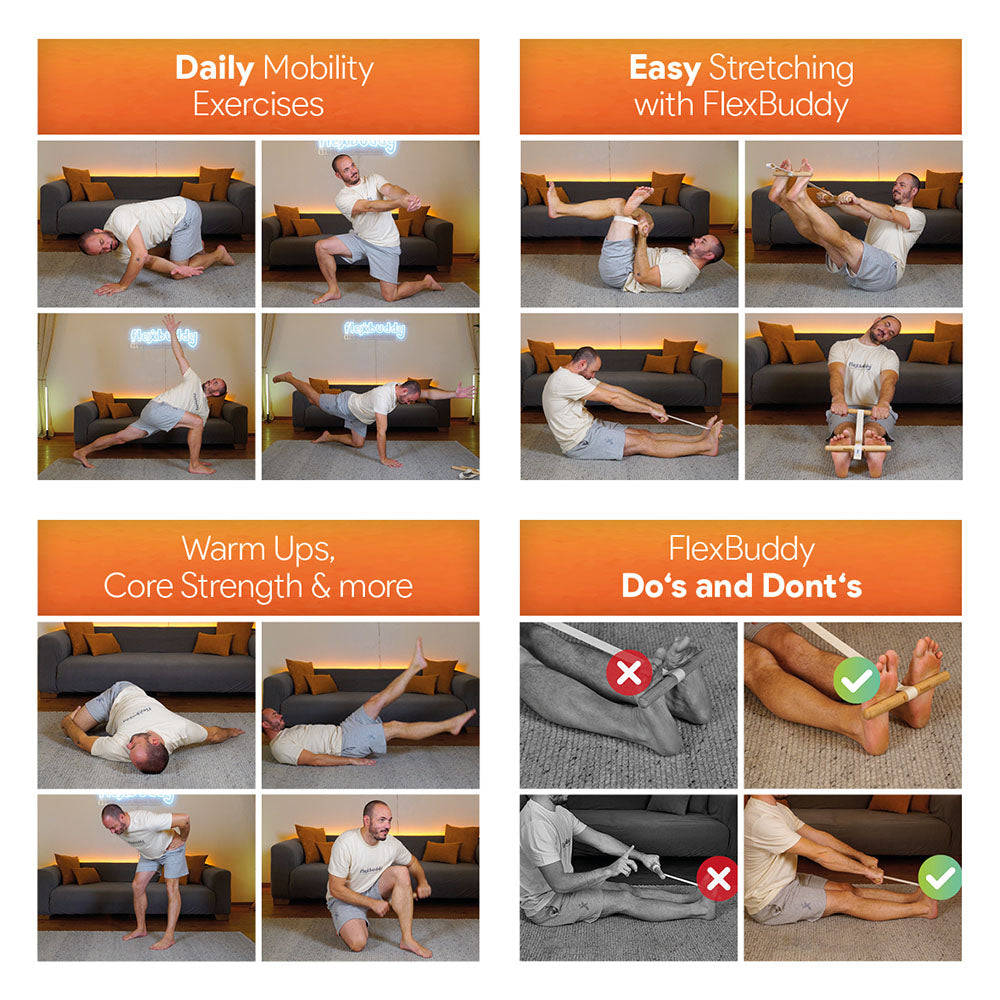
Stretch 1 matters most, and FlexBuddy® gives you its full version. It is a patented stretching device made of two beech-wood bars joined by an adjustable cotton strap. One bar goes under the soles of your feet, the other in your hands. Sit on the floor with both legs out, sit tall, lean back, tilt the hips forward, lift the chest and hold for ten deep breaths. The strap carries the reach, so your spine stays long and the pull lands in the hamstrings and calves together. Comfortable wooden handles, no rope burn, one size for every body.
"Sit at a desk 9 hours a day. My lower back used to ache every evening. Two weeks in, that's basically gone," wrote Stephen W. Two minutes a day can improve your flexibility and posture. It is rated 4.5 by verified buyers and comes with a 30-day money-back guarantee and a lifetime warranty. Get your FlexBuddy, or take the two-minute quiz to find your routine.
Frequently asked questions
What stretches can I do sitting in a chair?
A hamstring hinge, a figure-4 for the hips, a spinal twist, cat-cow, a side bend, a neck side bend, a chin tuck, a chest opener, ankle circles with calf pumps, and a wrist stretch. Hold each for 10 to 30 seconds, to about 60 seconds in total [1][2].
Are chair exercises good for seniors?
Yes. A review of 25 studies in adults aged 50 and over found that chair-based exercise improved grip strength and the ability to stand up from a chair [19]. The NHS suggests seated exercises at least twice a week, with balance and strength work [7].
How often should I stretch at my desk?
Briefly and often. In one trial of office workers, a 30-second stretch twice each working day, plus endurance exercises twice a week, more than halved new low back pain over a year [11]. Do a two-minute set mid-morning and mid-afternoon, and get up to move every hour or so [5].
Can you stretch your hamstrings in a chair?
Yes. At the front of the seat, straighten one leg, heel down, keep your spine long and tip forward from the hips until the back of the thigh pulls. Hold for 30 seconds, twice per leg. At home, FlexBuddy gives you the two-leg version on the floor.
What stretches can I do on a plane?
Ankle circles, calf pumps, a knee hug held for 15 seconds [6], a chin tuck, a neck side bend and a wrist stretch. Over four hours, walk the aisle as well, because long journeys raise the risk of blood clots [5].
Do chair stretches actually help?
Yes. Office workers who stretched for 10 to 15 minutes three times a week had lower neck, shoulder and low back pain scores after six months [4]. You will feel looser the first time you stand up.
This article is general information, not medical advice. Tight muscles usually respond well to regular stretching. If your pain is sharp, radiates down a leg, comes with numbness, weakness, fever, bladder or bowel changes, follows an injury, or keeps getting worse, see a doctor or physiotherapist before you stretch.
References
- Garber CE, Blissmer B, Deschenes MR, et al.; American College of Sports Medicine. Position stand: quantity and quality of exercise for developing and maintaining cardiorespiratory, musculoskeletal, and neuromotor fitness in apparently healthy adults: guidance for prescribing exercise. Med Sci Sports Exerc. 2011;43(7):1334–1359. doi:10.1249/MSS.0b013e318213fefb. PMID 21694556.
- Page P. Current concepts in muscle stretching for exercise and rehabilitation. Int J Sports Phys Ther. 2012;7(1):109–119. PMID 22319684; PMC3273886. https://pmc.ncbi.nlm.nih.gov/articles/PMC3273886/ (accessed 10 Nov 2026).
- Feland JB, Myrer JW, Schulthies SS, Fellingham GW, Measom GW. The effect of duration of stretching of the hamstring muscle group for increasing range of motion in people aged 65 years or older. Phys Ther. 2001;81(5):1110–1117. doi:10.1093/ptj/81.5.1110. PMID 11319936.
- Shariat A, Cleland JA, Danaee M, Kargarfard M, Sangelaji B, Tamrin SBM. Effects of stretching exercise training and ergonomic modifications on musculoskeletal discomforts of office workers: a randomized controlled trial. Braz J Phys Ther. 2018;22(2):144–153. doi:10.1016/j.bjpt.2017.09.003. PMID 28939263; PMC5883995.
- NHS. DVT (deep vein thrombosis). Page last reviewed 30 Apr 2026. https://www.nhs.uk/conditions/deep-vein-thrombosis-dvt/ (accessed 10 Nov 2026).
- Centers for Disease Control and Prevention. Understanding your risk for blood clots with travel. 15 May 2024. https://www.cdc.gov/blood-clots/risk-factors/travel.html (accessed 10 Nov 2026).
- NHS. Sitting exercises. Page last reviewed 18 Jan 2024. https://www.nhs.uk/live-well/exercise/sitting-exercises/ (accessed 10 Nov 2026).
- Jones O. Muscles of the Posterior Thigh: Hamstrings. TeachMeAnatomy, last updated 9 Apr 2026. https://teachmeanatomy.info/lower-limb/muscles/thigh/hamstrings/ (accessed 10 Nov 2026).
- NHS. Flexibility exercises. Page last reviewed 20 Nov 2023. https://www.nhs.uk/live-well/exercise/flexibility-exercises/ (accessed 10 Nov 2026).
- Restaino RM, Holwerda SW, Credeur DP, Fadel PJ, Padilla J. Impact of prolonged sitting on lower and upper limb micro- and macrovascular dilator function. Exp Physiol. 2015;100(7):829–838. doi:10.1113/EP085238. PMID 25929229; PMC4956484.
- Sihawong R, Janwantanakul P, Jiamjarasrangsi W. A prospective, cluster-randomized controlled trial of exercise program to prevent low back pain in office workers. Eur Spine J. 2014;23(4):786–793. doi:10.1007/s00586-014-3212-3. PMID 24492949; PMC3960439.
- Kuipers S, Cannegieter SC, Middeldorp S, Robyn L, Büller HR, Rosendaal FR. The absolute risk of venous thrombosis after air travel: a cohort study of 8,755 employees of international organisations. PLoS Med. 2007;4(9):e290. doi:10.1371/journal.pmed.0040290. PMID 17896862; PMC1989755.
- Department for Transport. The Highway Code: Rules for drivers and motorcyclists (89 to 102), Rule 91. GOV.UK, updated 22 Oct 2025. https://www.gov.uk/guidance/the-highway-code/rules-for-drivers-and-motorcyclists-89-to-102 (accessed 10 Nov 2026).
- NHS. Benefits of exercise. Page last reviewed 15 Aug 2024. https://www.nhs.uk/live-well/exercise/exercise-health-benefits/ (accessed 10 Nov 2026).
- NHS. Physical activity guidelines for older adults. Page last reviewed 15 Aug 2024. https://www.nhs.uk/live-well/exercise/physical-activity-guidelines-older-adults/ (accessed 10 Nov 2026).
- NHS. Low blood pressure (hypotension). Page last reviewed 11 Jul 2023. https://www.nhs.uk/conditions/low-blood-pressure-hypotension/ (accessed 10 Nov 2026).
- NHS. Recovering from a hip replacement. Page last reviewed 6 Mar 2024. https://www.nhs.uk/tests-and-treatments/hip-replacement/recovering-from-a-hip-replacement/ (accessed 10 Nov 2026).
- Royal Osteoporosis Society. How to exercise safely for bones. Last reviewed 1 Jun 2026. https://theros.org.uk/information-and-support/exercise/how-to-exercise-safely-for-bones/ (accessed 10 Nov 2026).
- Klempel N, Blackburn NE, McMullan IL, et al. The effect of chair-based exercise on physical function in older adults: a systematic review and meta-analysis. Int J Environ Res Public Health. 2021;18(4):1902. doi:10.3390/ijerph18041902. PMID 33669357; PMC7920319.
- Waongenngarm P, Areerak K, Janwantanakul P. The effects of breaks on low back pain, discomfort, and work productivity in office workers: a systematic review of randomized and non-randomized controlled trials. Appl Ergon. 2018;68:230–239. doi:10.1016/j.apergo.2017.12.003. PMID 29409639.
- Akkarakittichoke N, Waongenngarm P, Janwantanakul P. The effects of active break and postural shift interventions on recovery from and recurrence of neck and low back pain in office workers: a 3-arm cluster-randomized controlled trial. Musculoskelet Sci Pract. 2021;56:102451. doi:10.1016/j.msksp.2021.102451. PMID 34450361.
- Jones O. Muscles in the Anterior Compartment of the Thigh. TeachMeAnatomy, last updated 11 Oct 2026. https://teachmeanatomy.info/lower-limb/muscles/thigh/anterior-compartment/ (accessed 10 Nov 2026).