- Three muscles, one stretch. The hip flexors are iliopsoas, from the lumbar spine and pelvis to the inner thigh bone, rectus femoris down the front of the thigh, and tensor fasciae latae at the front corner of the pelvis [1][2].
- If you sit a lot, this stretch is for you. Adults who sat over 7 hours a day and moved little had about 6 degrees less hip extension than active people who sat under 4 hours [3].
- Tuck the pelvis and it works in a minute. In a 2024 trial, a kneeling lunge with a posterior pelvic tilt reduced the hip flexors' resistance in a single session; the same lunge without the tuck changed almost nothing [4].
- The dose is one minute per side. Two holds of 30 seconds, at least two to three days a week [5][6]. Office workers who held it for 30 seconds twice each workday, alongside trunk endurance exercises, more than halved their new back pain over a year [7].
- Your hips open within weeks. Range improves in three to six weeks [8][9], and eight weeks of strength training made the hip flexors 12.2% stronger [10].
- FlexBuddy® takes care of the other half. The lunge frees the front of the hip. FlexBuddy stretches the hamstrings at the back, with your spine tall.
What are the hip flexors?
"Hip flexor" is a job description: any muscle that crosses the front of the hip and lifts the thigh. Three of them matter for stretching. The guide to tight hips from sitting covers the whole hip; this article gives you the stretch for the front, done properly.
Iliopsoas
Two muscles with one attachment. Psoas major starts on the lumbar vertebrae, iliacus on the inner surface of the pelvic bone, and together they attach to the lesser trochanter, a bump on the inner thigh bone just below the hip joint. Their job is to flex the thigh at the hip [1]. Iliopsoas runs from spine and pelvis to leg, so the position of the pelvis decides how long it is.
Rectus femoris
The middle muscle of the quadriceps starts on the front of the pelvis and ends on the kneecap. It is the only quadriceps muscle that crosses both hip and knee [1], so it reaches full length only with the hip extended and the knee bent, which is why some versions of the stretch bring the heel towards the buttock.
Tensor fasciae latae
A small muscle that starts on the front of the iliac crest and feeds into the iliotibial tract, the band down the outside of the thigh. It helps lift the leg sideways and turn it inwards [2]. It sits at the front of the hip, so the standard clinical test reads it together with iliopsoas and the quadriceps [11].
Does sitting really shorten your hip flexors?
A chair holds the hip bent, the short position for all three muscles, and research ties long sitting to stiffer hips. The good news: they respond well to a short daily stretch.
Sitting and stiff hips go together. In a 2021 University of Salford study, adults who sat more than 7 hours a day and did under 150 minutes of activity a week had 6.1 degrees less hip extension than active people who sat under 4 hours. Its authors call it the first study to show the link [3]. If that is your week, you have the most to gain.
You can check your own. The traditional standard is a thigh that reaches horizontal in the test below; 117 elite athletes averaged about 12 degrees below horizontal [11], and one research group counts only a drop of more than 15 degrees as normal [12]. The secret of a true reading is a still pelvis: uncontrolled pelvic tilt explained most of the error in the study that checked [13]. The same rule makes the stretch work.
The stretch belongs in a back-friendly day. Researchers have examined the link between hip movement and low back pain across 24 studies [14]. The most encouraging trial is about prevention. In a 12-month trial of 563 healthy office workers with below-normal trunk flexibility or endurance, 8.8% of those given a 30-second iliopsoas stretch twice each workday plus twice-weekly trunk endurance exercises developed low back pain, against 19.7% of the control group [7]. Less than half the back pain, from a 30-second stretch at the desk and a little trunk work.
So if you sit most of the day, a short daily stretch is one of the best habits you can give your hips. Lower back pain from sitting tells the back's side of the story, and anterior pelvic tilt covers posture.
How to test your hip flexors at home
Physiotherapists use the modified Thomas test. A firm bed will do.
- Sit on the very end of the bed, roll back and hug both knees to your chest, so the lower back is flat and the pelvis tucked [11].
- Keep one knee held firmly to the chest and let the other leg hang off the end, relaxed [11].
- Film the hanging leg from the side.
- Thigh height reads iliopsoas. Level with the bed or below is fine. A thigh that floats above horizontal is what researchers count as restricted [12].
- Knee bend reads rectus femoris. The elite athletes' knees hung at about 52 degrees of bend, well short of the textbook 90 [11]. A knee that kicks out nearly straight points to a short one.
- Outward drift reads tensor fasciae latae. Some is normal; the athletes averaged 15 to 16 degrees [11].
One rule: do not let go of the knee at your chest. If it drifts away, the pelvis rotates forwards, the hanging thigh drops and the test flatters you [11][13]. Test both sides; differences between them are worth working on [11].
The hip flexor stretch, step by step
This is the half-kneeling version used in the trial that compared techniques [4]. You need a cushion and two minutes.
- Set up. Kneel on your right knee on a cushion, left foot planted in front, both knees at about a right angle. Trunk upright, hands on hips.
- Tuck the pelvis. Picture the pelvis as a bowl of water and tip it so the water spills out behind you: tailbone under, belt buckle pointing slightly up, ribs down. This posterior pelvic tilt is most of the stretch.
- Squeeze the glute. Tighten the right buttock. Gluteus maximus is the main extensor of the hip [2], and keeping it on holds the tuck while you move.
- Shift forward, a little. Move the whole pelvis forward a few centimetres and stop when a firm pull appears high at the front of the right hip. If the lower back starts to arch, come back, tuck again and go less far.
- Hold and breathe. Thirty seconds, no bouncing. Rest, repeat once, change sides. Two 30-second holds was the dose in the trial [4] and matches the guideline total of 60 seconds [5].
What you should feel: a firm pull at the crease of the kneeling hip, perhaps a hand's width down the thigh, and nothing in the lower back. Stand up and that hip feels longer and lighter. Stop at anything sharp, as the trial's participants were told to [4].
To make it stronger, do not sink deeper. Reach the arm on the kneeling side straight up, or bend the back knee more to bring in rectus femoris.
The pelvic-tilt mistake: why arching your back cancels the stretch
Most people stretch their hip flexors with a long, deep lunge: chest proud, hips sinking, lower back arched. It looks like a big stretch and is mostly a back bend. The fix takes one second.
Psoas starts on the lumbar spine, iliacus inside the pelvis and rectus femoris on the front of the pelvis, and all three end on the leg [1]. A muscle is stretched when its two ends move apart. In the deep lunge the thigh goes back, but the pelvis tips forward and follows it while the lumbar spine arches to keep you upright. The ends travel together, and the lower back supplies the movement the hip did not make. Researchers describe the same compensation: people make up for limited hip extension by tilting the pelvis forwards [4], and when it tilts there is less tension on iliopsoas and the quadriceps [11]. Tuck, and the ends move apart.
The 2024 trial tested it directly. Healthy, active adults with tight hip flexors stretched one leg with the conventional kneeling lunge and the other with the same lunge plus a posterior pelvic tilt, two holds of 30 seconds each. The researchers measured how strongly the hip flexors resisted the leg lying flat. With the tuck, that resistance fell from 18.8 to 14.0 newton-metres; without it, it stayed at 17.6 [4].
One minute of stretching, one small tuck, and the hip had measurably let go.
Four hip flexor stretch variants, and who each suits
The rule is the same in all four: tuck first, squeeze the buttock of the side being stretched, then move.
| Variant | How to do it | Hold | Who it suits |
|---|---|---|---|
| Half-kneeling lunge | Back knee on a cushion, front foot planted; tuck, squeeze, shift the hips forward a few centimetres | 30 s, twice per side | Most people; the version tested in the trial [4] |
| Standing split stance | One foot a stride back, hand on a desk; tuck, squeeze the back-leg buttock, press that hip forward | 30 s per side, twice a working day, the office-trial schedule [7] | The office, sore knees, anyone avoiding the floor |
| Couch stretch | Back shin up against a sofa or wall, knee fully bent, front foot planted; tuck hard before lifting the trunk | 20–30 s, twice per side | Runners and cyclists; adds rectus femoris, which also crosses the knee [1]. Not for sore knees |
| Lying off the bed edge | The Thomas test position: one knee hugged to the chest, the other leg hanging, relaxed | 30–60 s per side | Mornings, older adults, backs that complain in a lunge; the hugged knee holds the pelvis for you [11] |
The standing version is the mildest and the easiest to repeat through a working day. If the couch stretch is too much for your knee, the tight hips guide has a gentler kneeling version in which a strap draws the back heel in.
How long to hold a hip flexor stretch, and how often
The dose is small. The American College of Sports Medicine recommends flexibility exercises totalling 60 seconds per exercise for each major muscle-tendon group, on at least two days a week [5]. Harvard Health puts it at two to three times a week, the 60 seconds split as you like [6]. A clinical review adds: holds of 15 to 30 seconds, two to four repetitions, after an active warm-up, and longer holds for older adults [15].
- Standard: two holds of 30 seconds per side, three or more days a week, after a couple of minutes of walking.
- Desk workers: one 30-second hold per side mid-morning and mid-afternoon, standing, the schedule from the office-worker trial [7].
- Over 65: the bed-edge version, with holds towards 60 seconds [15].
- Before sport: go ahead. In a meta-analysis of eight studies, hip flexor stretching of up to 120 seconds did not impair performance; keep totals of 270 seconds and more for afterwards [16].
The general rules are in how long to hold a stretch; cyclists, who spend hours folded at the hip, have their own routine in stretching for cyclists.
How long until they loosen? A few weeks. In a randomised trial of young patients with limited hip extension, home stretching improved range over six weeks [8]. Six weeks of a daily five-minute lunge stretch improved the Thomas test by about 6 degrees [17]. Healthy older adults who stretched twice a day at home for ten weeks raised their hip extension from 6.1 to 7.7 degrees [18].
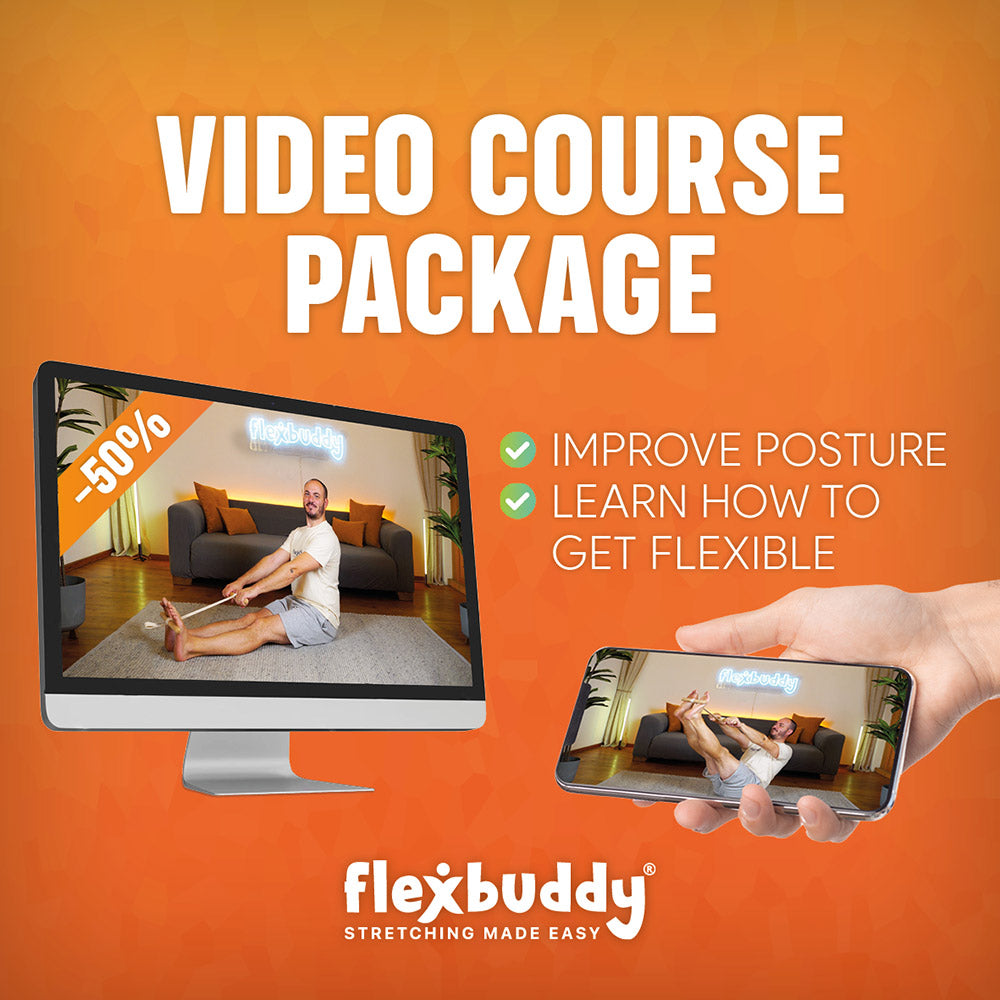
How to keep it up. Keep a cushion by the desk for the front of the hips and FlexBuddy by the sofa for the back of the legs, and the habit runs itself.
Strengthen the hip flexors and glutes too
Stretching opens the hip. Strength makes the new range yours.
Range comes quickly. Healthy adults with limited hip extension stretched at home for three weeks, and their passive hip extension improved [9]. Strength work puts that new range to use.
Tight flexors travel with quiet glutes. Among female college soccer players, those with restricted hip flexor length showed less gluteus maximus activation in a squat than those with normal length [12]. It fits the glute squeeze in the stretch, which costs nothing: active stretching, with the opposite muscle contracting, improved hip extension as much as passive stretching [8].
The hip flexors love training. After eight weeks of hip flexion resistance training, active but untrained adults had 12.2% more hip flexion strength and faster sprint and shuttle-run times [10].
The guideline is resistance exercise for each major muscle group on two to three days a week [5]. A minimum set: glute bridges with the pelvis tucked as in the stretch, two sets of 12; a standing march, knee above hip height and held for five seconds, two sets of 8 per side; and standing up from your chair without your hands, ten times, every hour or so.
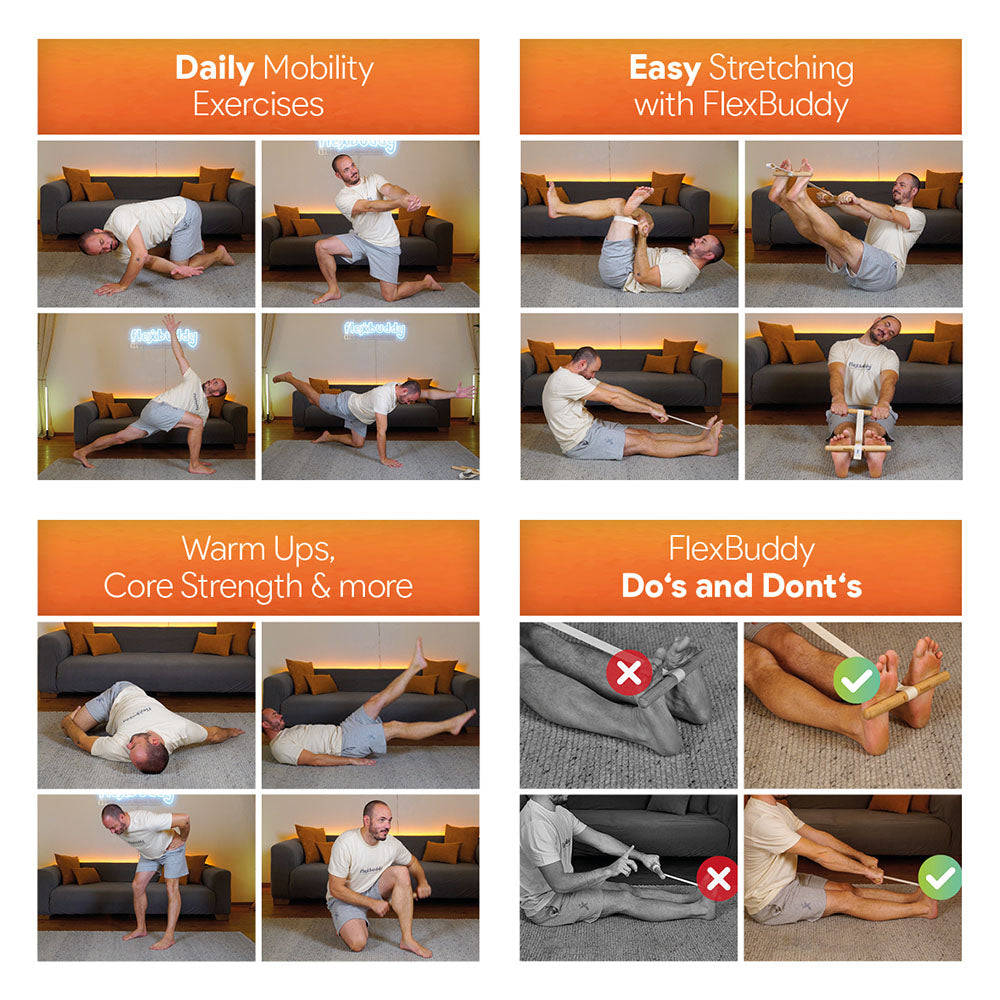
The hip flexors are only the front half of the pelvis; the hamstrings attach to the sitting bones at the back [19]. That half belongs to FlexBuddy. Foot bar under your soles, the other bar in your hands, sit tall, lean back and tilt the hips forward: ten deep breaths, a 30-second pause, three times. The lunge teaches your pelvis to tuck, FlexBuddy teaches it to tip forward, and hips that can do both feel free.
When hip pain from sitting is not a tight muscle
Stiffness at the front of the hip that eases after a few steps is the ordinary cost of a long sit, and what this stretch is for. Three patterns are different.
- A strain. A tear in the muscle, common in running, football and hockey, with pain, a pulling tightness, a limp and sometimes bruising or swelling. It needs rest and ice first, not stretching, and most heal in a few weeks [20].
- The joint. See a GP if hip pain has not improved after two weeks of self-care, keeps coming back, or comes with stiffness lasting more than 30 minutes after waking [21].
- Urgent signs. Severe pain that started suddenly without a fall, a hip that is hot and swollen, or pain with a high temperature need same-day medical advice [21].
Pain deep in the buttock is the back of the hip, not the front; see the piriformis stretch guide.

Free the whole hip with FlexBuddy
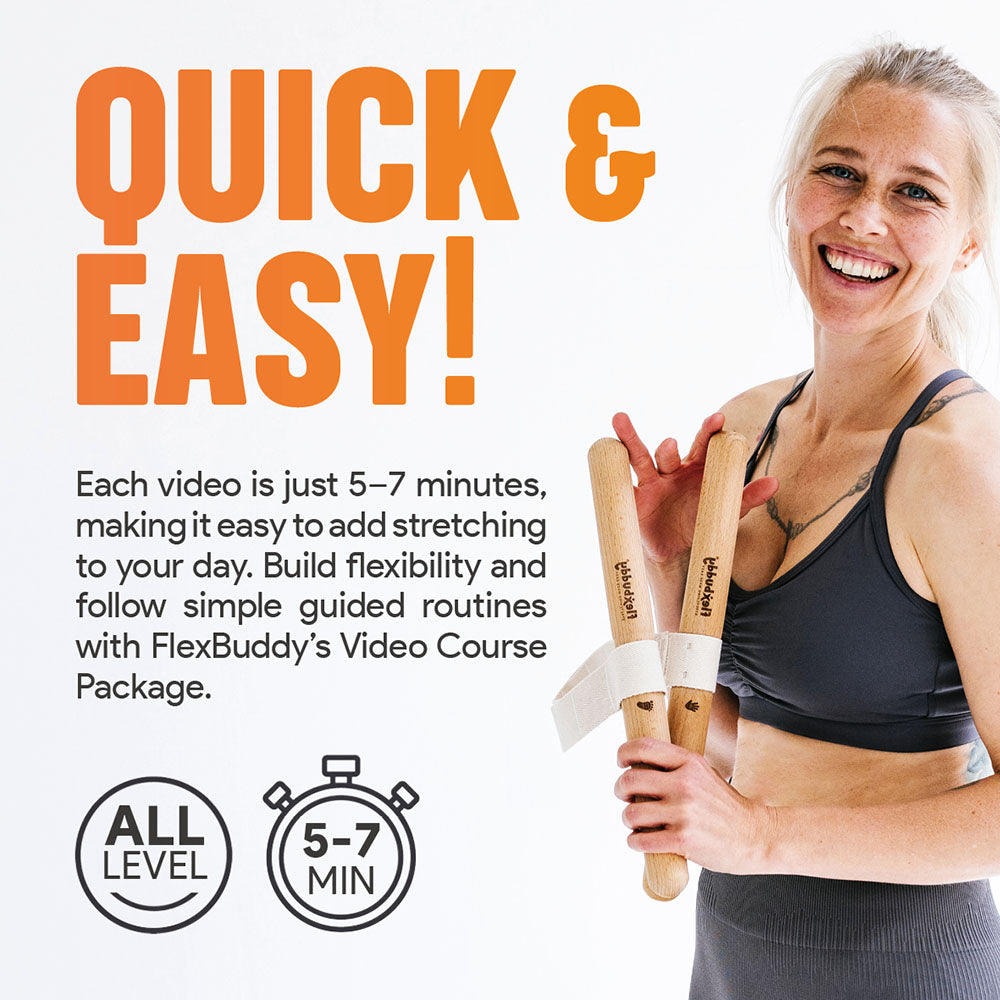
The lunge frees the front of your hips. FlexBuddy® looks after the other half: the hamstrings. It is a patented stretching device made of two beech-wood bars joined by an adjustable cotton strap: one bar under your feet, the other in your hands. You sit tall, tilt the hips forward, and the strap carries the reach, so the stretch lands in your hamstrings and calves while your back stays long. With the strap as a loop around both feet, the same support keeps you upright in the Butterfly. Comfortable wooden handles, no rope burn, one size for every body.
Together they answer a day in a chair. "As a cyclist, I'm naturally overbalanced with flexibility issues in my hamstrings. At 60 I thought my hip pain wouldn't cease…" wrote Scott T., a verified buyer. Two minutes a day can improve your flexibility and posture. It is rated 4.5 by verified buyers and comes with a 30-day money-back guarantee and a lifetime warranty, so you can try it without risk. Get your FlexBuddy, or take the two-minute quiz to see where you start.
Frequently asked questions
How do you release a tight hip flexor?
With one small move: tuck the pelvis. Kneel on one knee, tip the tailbone under, squeeze that buttock and shift the hips a few centimetres forward, for 30 seconds, twice per side. In a 2024 trial this version reduced hip flexor resistance in a single session [4].
How long does it take to loosen tight hip flexors?
You feel the first session, and the range follows within three to six weeks of regular stretching [8][17]. Older adults gained too, in ten weeks of stretching at home [18].
Can tight hip flexors cause lower back pain?
Here is the part you can use: a twice-daily hip flexor stretch plus trunk endurance work more than halved new back pain in office workers over a year [7]. Hip movement and back pain have been examined together across 24 studies [14], and that is the result to act on.
What is the best psoas stretch?
The half-kneeling lunge with a posterior pelvic tilt: it is the version that worked in the trial [4]. Psoas shares its attachment with iliacus and stretches together with the other hip flexors [1]. If kneeling hurts, use the bed-edge version.
Should I stretch my hip flexors every day?
Yes, and if you sit all day you will love it. Guidelines set a minimum of two to three days a week [5][6]; the office-worker trial used 30 seconds twice every working day [7]. Keep it to a firm pull, rest a muscle you may have strained [20], and add the FlexBuddy hamstring stretch for the back of the hips.
This article is general information, not medical advice. Tight muscles usually respond well to regular stretching. If your pain is sharp, radiates down a leg, comes with numbness, weakness, fever, bladder or bowel changes, follows an injury, or keeps getting worse, see a doctor or physiotherapist before you stretch.
References
- Jones O. Muscles of the Anterior Thigh. TeachMeAnatomy, last updated 11 Oct 2026. https://teachmeanatomy.info/lower-limb/muscles/thigh/anterior-compartment/ (accessed 10 Nov 2026).
- Jones O. Muscles of the Gluteal Region. TeachMeAnatomy, last updated 9 Apr 2026. https://teachmeanatomy.info/lower-limb/muscles/gluteal-region/ (accessed 10 Nov 2026).
- Boukabache A, Preece SJ, Brookes N. Prolonged sitting and physical inactivity are associated with limited hip extension: a cross-sectional study. Musculoskelet Sci Pract. 2021;51:102282. doi:10.1016/j.msksp.2020.102282. PMID 33188982.
- González-de-la-Flor Á, Cotteret C, García-Pérez-de-Sevilla G, Domínguez-Balmaseda D, Del-Blanco-Muñiz JÁ. Comparison of two different stretching strategies to improve hip extension mobility in healthy and active adults: a crossover clinical trial. BMC Musculoskelet Disord. 2024;25(1):853. doi:10.1186/s12891-024-07988-9. PMID 39462416; PMC11515218.
- Garber CE, Blissmer B, Deschenes MR, et al.; American College of Sports Medicine. Position stand: quantity and quality of exercise for developing and maintaining cardiorespiratory, musculoskeletal, and neuromotor fitness in apparently healthy adults. Med Sci Sports Exerc. 2011;43(7):1334–1359. doi:10.1249/MSS.0b013e318213fefb. PMID 21694556.
- Harvard Health Publishing. The ideal stretching routine. Harvard Medical School, 16 Mar 2026 (reviewed by H. E. LeWine, MD). https://www.health.harvard.edu/staying-healthy/the-ideal-stretching-routine (accessed 10 Nov 2026).
- Sihawong R, Janwantanakul P, Jiamjarasrangsi W. A prospective, cluster-randomized controlled trial of exercise program to prevent low back pain in office workers. Eur Spine J. 2014;23(4):786–793. doi:10.1007/s00586-014-3212-3. PMID 24492949; PMC3960439.
- Winters MV, Blake CG, Trost JS, et al. Passive versus active stretching of hip flexor muscles in subjects with limited hip extension: a randomized clinical trial. Phys Ther. 2004;84(9):800–807. PMID 15330693.
- Mettler JH, Shapiro R, Pohl MB. Effects of a hip flexor stretching program on running kinematics in individuals with limited passive hip extension. J Strength Cond Res. 2019;33(12):3338–3344. doi:10.1519/JSC.0000000000002586. PMID 29927892.
- Deane RS, Chow JW, Tillman MD, Fournier KA. Effects of hip flexor training on sprint, shuttle run, and vertical jump performance. J Strength Cond Res. 2005;19(3):615–621. doi:10.1519/14974.1. PMID 16095411.
- Harvey D. Assessment of the flexibility of elite athletes using the modified Thomas test. Br J Sports Med. 1998;32(1):68–70. doi:10.1136/bjsm.32.1.68. PMID 9562169; PMC1756061.
- Mills M, Frank B, Goto S, et al. Effect of restricted hip flexor muscle length on hip extensor muscle activity and lower extremity biomechanics in college-aged female soccer players. Int J Sports Phys Ther. 2015;10(7):946–954. PMID 26673683; PMC4675195.
- Vigotsky AD, Lehman GJ, Beardsley C, Contreras B, Chung B, Feser EH. The modified Thomas test is not a valid measure of hip extension unless pelvic tilt is controlled. PeerJ. 2016;4:e2325. doi:10.7717/peerj.2325. PMID 27602291; PMC4991856.
- Avman MA, Osmotherly PG, Snodgrass S, Rivett DA. Is there an association between hip range of motion and nonspecific low back pain? A systematic review. Musculoskelet Sci Pract. 2019;42:38–51. doi:10.1016/j.msksp.2019.03.002. PMID 31030110.
- Page P. Current concepts in muscle stretching for exercise and rehabilitation. Int J Sports Phys Ther. 2012;7(1):109–119. PMID 22319684; PMC3273886. https://pmc.ncbi.nlm.nih.gov/articles/PMC3273886/ (accessed 10 Nov 2026).
- Konrad A, Močnik R, Titze S, Nakamura M, Tilp M. The influence of stretching the hip flexor muscles on performance parameters: a systematic review with meta-analysis. Int J Environ Res Public Health. 2021;18(4):1936. doi:10.3390/ijerph18041936. PMID 33671271; PMC7922112.
- Ehresman BA, Lehecka BJ, Hiser D, Koster L, Wietharn J. Improved hip flexibility and gluteal function following a daily lunge-and-reach stretching intervention. Int J Sports Phys Ther. 2025;20(6):814–823. doi:10.26603/001c.137692. PMID 40469644; PMC12129636.
- Kerrigan DC, Xenopoulos-Oddsson A, Sullivan MJ, Lelas JJ, Riley PO. Effect of a hip flexor-stretching program on gait in the elderly. Arch Phys Med Rehabil. 2003;84(1):1–6. doi:10.1053/apmr.2003.50056. PMID 12589613.
- Jones O. Muscles of the Posterior Thigh: Hamstrings. TeachMeAnatomy, last updated 9 Apr 2026. https://teachmeanatomy.info/lower-limb/muscles/thigh/hamstrings/ (accessed 10 Nov 2026).
- Cleveland Clinic. Hip Flexor Strain. Last updated 3 Aug 2022. https://my.clevelandclinic.org/health/diseases/23978-hip-flexor-strain (accessed 10 Nov 2026).
- NHS. Hip pain in adults. Page last reviewed 20 Nov 2025. https://www.nhs.uk/symptoms/hip-pain/ (accessed 10 Nov 2026).