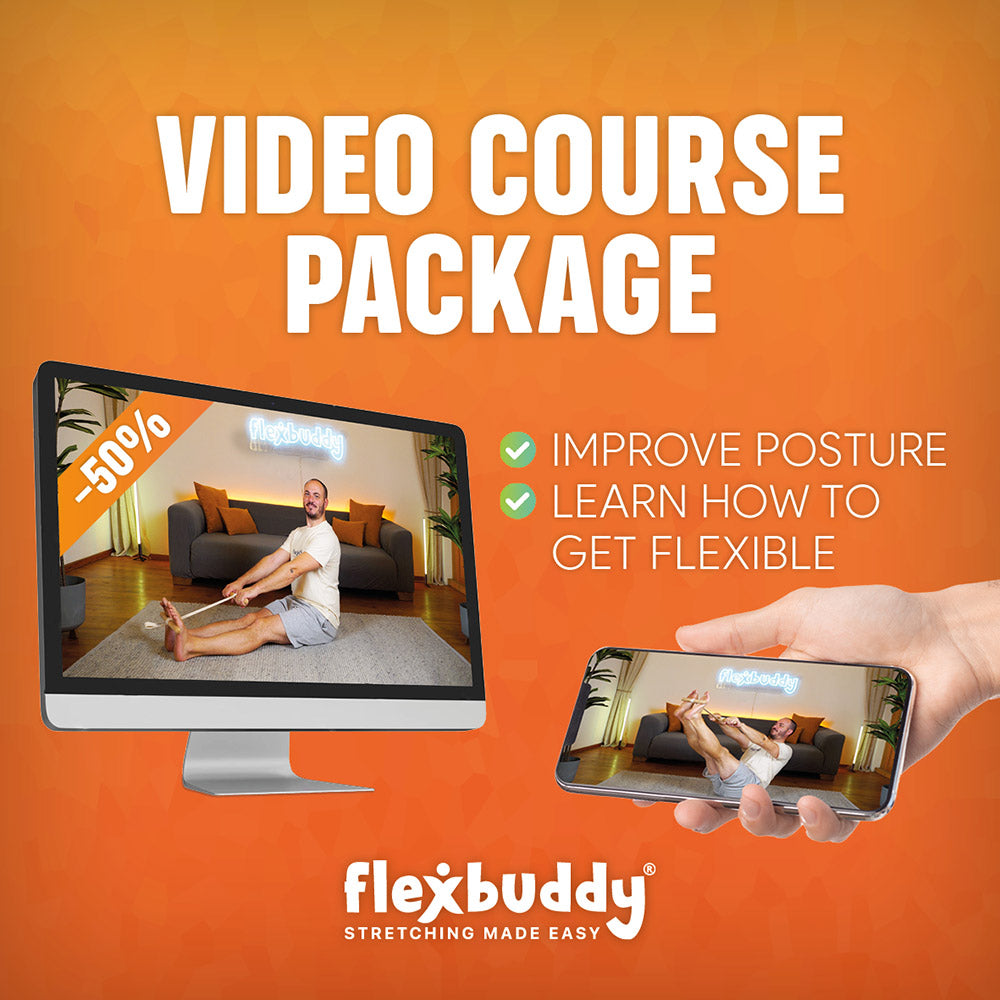
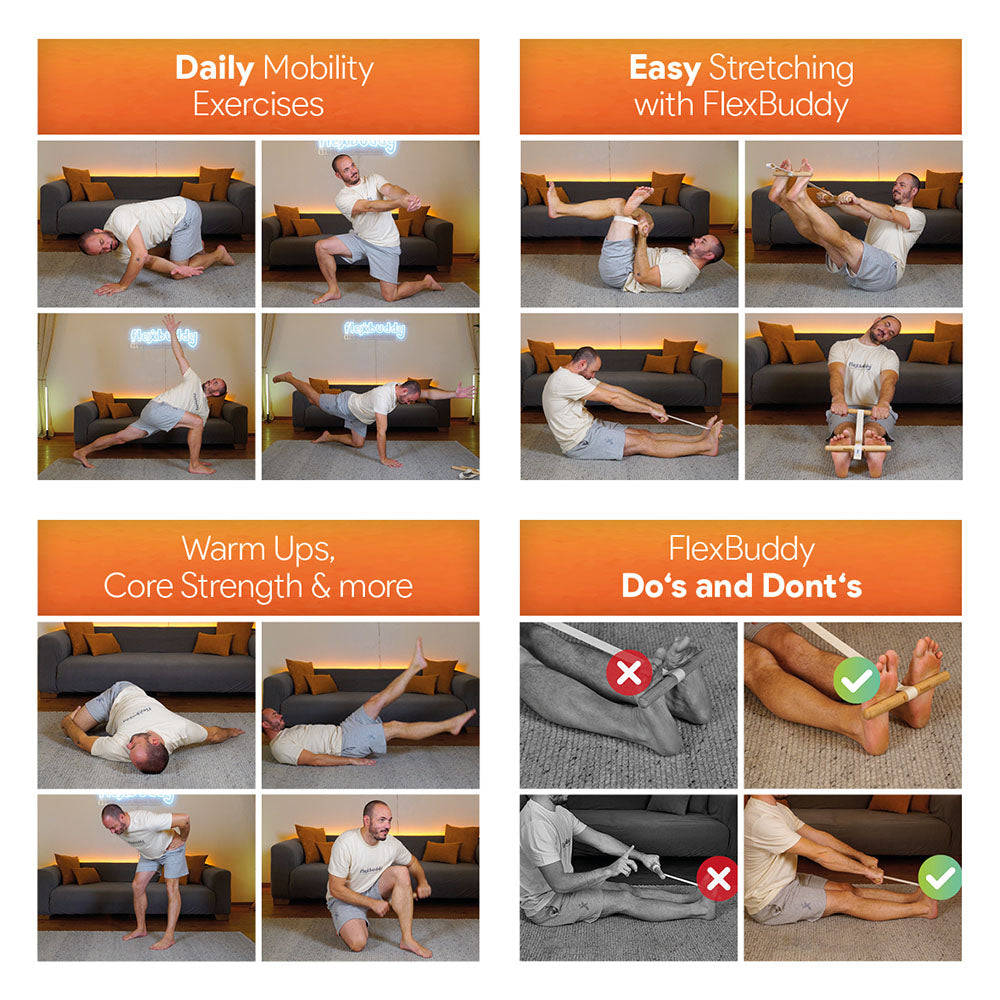
- You can get there. Touching your toes is a hip movement before it is a back movement. Fold at the hips with a long spine and the stretch lands in the back of the thighs.
- Measure first, then watch the number move. The sit-and-reach tracks your hamstrings [1], so it is the right progress check for this plan.
- Thirty seconds is enough. A 30-second hamstring stretch once a day, five days a week, improved knee-extension range in six weeks, and did as well as longer or more frequent holds [2]. That sits inside the guideline of about 60 seconds per stretch on at least two or three days a week [3][4].
- You feel it in week one. Your nervous system lets you go further from the first sessions [5], and six to eight weeks of stretching is the window for longer hamstrings [6].
- Little and often wins. Days per week and minutes per week drive the gains, not the length of any one session [7], and people who stretched at least six times a week gained 24 per cent in four weeks [8].
- The habit keeps the range. When one group took four weeks off, the gain went; back to stretching, and it returned [9]. A few minutes a day holds on to it.
- FlexBuddy® makes the plan easy to do well. It keeps your spine long while the strap carries the reach, and it shortens one loop at a time, exactly as this plan does.
First, why you cannot touch your toes yet
The reason is almost always simple, and it is trainable. If you have not done it yet, start with why can't I touch my toes, which gives you a five-minute self-test to find out whether the hamstrings, calves, hips or lower back are holding you back. This article works on the usual answer: the hamstrings, with the calves as a junior partner.
The hamstrings run from the ischial tuberosity, the bone you sit on, to the tibia and fibula just below the knee [10]. When they are short and the knee is straight, they hold the pelvis back, and the only way to get your hands lower is to round the lower back. That is why years of reaching never got you any nearer: the hamstrings were never the part being stretched. It was not you. It was the method.
The fix is to stop the back doing the reaching, so the pull lands in the legs, and then to repeat a dose the muscle adapts to. If your self-test pointed at the nerve or a sore back, read the tight hamstrings guide first.
Measure first: your baseline
In four weeks you will want proof of how far you have come, so take two numbers now. Shoes off, after a minute of marching on the spot, at the same time of day each time.
Standing toe touch (fingertip-to-floor)
Feet hip-width apart, knees straight but not forced back, fold forward and let the arms hang. Have someone measure from your longest fingertip to the floor in centimetres. Then bend the knees slightly and repeat. The gap between the two numbers shows roughly how much the back of the legs is holding you.
Sit-and-reach at home
Sit on the floor with your legs straight and your feet flat against a step or a box. Lay a ruler on top with its zero at the line of your feet. Reach forward slowly with one hand on top of the other and read where your fingertips stop: minus centimetres short of the feet, plus beyond them. The furthest point you can hold for two seconds counts.
A meta-analysis of 34 studies found that sit-and-reach tests track hamstring flexibility far more than they track the lower back, and the classic feet-against-the-box version was the best of them [1]. So use it to follow your own progress, week by week. Norm tables and the more precise knee-extension measure are in hamstring flexibility test.
The rule: hinge at the hips, long spine, never bounce
Hinge at the hips. The movement comes from the pelvis tipping forward over the thigh bones, not from the spine curling. Chest lifted, sitting bones pushed back, the fold at the hip crease. Put a hand on your lower back as you fold: the moment it rounds, you have run out of hamstring and started borrowing from the spine. Stop just before that point.
Long spine, honest reach. With a long spine most people's hands stop well short of the toes at first. That is correct. FlexBuddy, a strap or a towel round the feet lets you keep the chest up without having to reach. With FlexBuddy, one bar sits under your feet, the other in your hands, and the strap carries the pull while you sit tall.
Never bounce. Ballistic stretching, bouncing at the end of the range, is no longer recommended for general fitness because of the increased risk of injury [6]. Still holds also work better: a 2024 meta-analysis of 77 studies found that static and PNF (contract-relax) stretching produced greater long-term gains in range than ballistic or dynamic stretching [11]; a review of 23 long-term studies favoured static holds too [7]. Breathe slowly and stretch to a clear pull, never to pain.
The 4-week plan at a glance
The dose comes straight from the research, and it is small. Adults aged 21 to 39 with limited hamstring flexibility stretched five days a week for six weeks, holding for 30 or 60 seconds, once or three times a day. Every stretching group gained knee-extension range, and 30 seconds once a day did as well as any of the longer options [2]. The American College of Sports Medicine recommends a total of 60 seconds per flexibility exercise on at least two days a week [3], which Harvard Health summarises as at least two to three times a week, with the 60 seconds made of four 15-second or three 20-second holds [4].
| Stretch | Position | Hold | Reps | Days |
|---|---|---|---|---|
| Weeks 1–2: learn the position | ||||
| Lying strap stretch | On your back, other knee bent, FlexBuddy foot bar or a strap round the foot; raise the straight leg until the thigh pulls, lower back on the floor | 30 s (about 10 slow breaths) | 2 per leg | Daily, at least 5 |
| Seated straight-back stretch | Sit tall, legs straight, FlexBuddy or a strap round the feet; tip the pelvis forward, chest up, stop at the thigh pull | 30 s | 2 | Daily, at least 5 |
| Straight-knee calf stretch | Hands on a wall, back leg straight, heel down, hips forward | 30 s | 2 per leg | Daily, at least 5 |
| Weeks 3–4: add standing, volume and hips | ||||
| Standing hip hinge | Feet hip-width, knees soft, hands sliding down the thighs, long spine, fold until the thighs pull | 30 s | 2–3 | Daily |
| Seated straight-back stretch, one step shorter | As before with the strap one loop shorter, as long as the back stays long | 30 s (up to 60 s for older adults) | 3 | Daily |
| Lying strap stretch | As before; pull the toes towards you at the end of the hold to reach the calf | 30 s | 2 per leg | Daily |
| Seated figure-four | Sit tall, one ankle on the other knee, hinge forward with a long spine until the outer hip pulls | 30 s | 2 per side | 3–4 days |
That is about five minutes a day at first and seven later. Every day is what counts: the review of 23 long-term studies found that time per week and days per week predicted gains, with improvements when a muscle group got at least five minutes a week over at least five days [7]. On a busy day, cut reps before you cut days.
Weeks 1 and 2: learn the position
The first fortnight teaches your body what a real hamstring stretch feels like: a pull in the back of the thigh and nowhere else. You will feel looser within days.
Lying strap stretch
Start here, because the floor holds your spine straight for you. Lie on your back, one knee bent with the foot flat, and put the FlexBuddy foot bar, a strap or a belt under the sole of the other foot. Keep that knee straight and raise the leg until you feel a clear pull in the back of the thigh. If the lower back lifts, lower the leg a little. Hold for ten slow breaths, lower, repeat. If one side is tighter, give it a third hold.
Seated straight-back stretch
This is the stretch that takes you to your toes, and the one FlexBuddy was built for. Sit on the floor with your legs straight, the foot bar under the soles of both feet and the hand bar in both hands, or a strap round both feet. Before you fold, sit as tall as you can and let the pelvis roll forward onto the front of the sitting bones. With the chest lifted and the arms long, tip forward from the hips until the thighs pull. The strap carries the reach, so your back stays long and the whole stretch goes into the hamstrings. If your lower back is what you feel, you have rounded: ease off and lengthen again.
Straight-knee calf stretch
The gastrocnemius, the big calf muscle, starts on the femoral condyles above the knee and inserts on the heel bone through the calcaneal tendon [12]. With the knee locked, a short calf adds tension to the whole back of the leg. Stand facing a wall, one foot back with the heel down and the knee straight, and move the hips forward until the calf pulls.
Weeks 3 and 4: standing, longer, wider
The second fortnight adds the standing version, raises the weekly volume and brings in the hips.
Standing hip hinge
This is the toe touch done properly. Feet hip-width, knees soft, hands on the front of the thighs. Push the hips back as if closing a drawer with your bottom and slide the hands down the thighs with the chest lifted. Stop when the thighs pull, for most people somewhere between the knees and mid-shin. Hold, come up by pushing the hips forward, repeat. It fits well after a walk or a run, and before training too: a systematic review of 106 studies found that static holds shorter than 60 seconds do not compromise maximal muscle performance [13].
One step shorter, and three reps
Shorten the seated stretch by one step. With FlexBuddy that is one loop on the foot bar for a big step, or a turn of the strap round the hand bar for a fine one. If the spine stays long at the new length, keep it: that is progress you can count. If it rounds, stay at the old length for another week. Go from two holds to three, and keep them at 30 seconds: in the dose trial, 30 seconds did as well as 60 in adults in their twenties and thirties [2]. Older adults do well with 60-second holds, which were linked with greater hamstring gains [6].
Add the hips
The deep hip rotators and the gluteals also resist the pelvis tipping forward, and they are often tight in people who sit. The seated figure-four reaches them without loading the back. Pull the toes towards you at the end of the lying strap stretch and the calf joins in.
What you gain in week 1, and after a month
In the first days you will go noticeably further. That gain is real: a review of the physiology attributes the increases in range after a single session and after programmes of three to eight weeks to modified sensation, your nervous system allowing more stretch [5]. A clinical commentary agrees [6].
Week 1: the same stretch feels milder, at a greater depth. Weeks 2 to 4: you keep gaining and the standing test starts to close. Weeks 6 to 8: the window in which hamstring length itself has been shown to change [6]. Four weeks is long enough to see your own numbers move, and that makes the next four easy.
In one trial, four weeks of hamstring stretching improved hip range in every stretching group, and people who did at least six sessions a week gained more than those who did three (24% against 16.8%). Four weeks after everyone stopped, some of the gain was still there [8]. In another trial, two 30-second stretches a day, five days a week for six weeks, raised knee-extension range from 143 to 152 degrees. A four-week break took it back to the start, and six more weeks of stretching brought it back [9].
Keep the short daily habit and the range stays yours. Leave FlexBuddy where you can see it and the few minutes take care of themselves. The longer view, by age and starting point, is in how long does it take to get flexible.
Seven fixes that keep progress coming
If the tape slows down, one of these almost always gets it moving again. The full list is in stretching mistakes.
- Keep the back long. Film your seated stretch from the side: the pelvis should tip before the lumbar spine curls. FlexBuddy carries the reach so it can.
- Stretch to a firm pull, never into pain. A stretch that hurts triggers the guarding you are trying to switch off. Aim for a pull you could hold for a minute.
- Hold still. The long-term reviews favour still holds over bouncing [7][11].
- Five short sessions, not one long Sunday. Days per week and total weekly time predicted gains; session length did not [7].
- Breathe. Bracing stiffens everything. Count ten slow breaths instead of seconds.
- Warm up for a minute. The general-fitness guidance is static stretching preceded by an active warm-up [6]. A minute of marching is enough.
- Give calves and hips their share. If they are your real limiter, that is where your centimetres are hiding.
If you plateau
A plateau usually means you have earned the next step: the stretch quietly became easy and nobody shortened it. Go one step shorter, back still long, for a week. If that is not it, change the stimulus, not the effort. Swap one seated hold for contract-relax: at the end of the hold, press the heels gently into the floor against the strap for five seconds, relax, and ease a little further. PNF techniques of this kind were, alongside static holds, the methods with the largest long-term gains in the 2024 meta-analysis [11].
Judge yourself by your own range too: hip sockets and limb proportions differ, and a longer, more comfortable bend is the win wherever your fingertips end up. One thing to watch: if the pull is electric, one-sided or runs into the calf and foot, or the back hurts after every session, see a physiotherapist instead of pushing.

Do the plan properly with FlexBuddy
The plan asks for two things that are hard to do with your hands on your shins: a chest that stays up while the hips fold, and a reach that gets exactly one step shorter each week. FlexBuddy® gives you both. It is a patented stretching device made of two beech-wood bars joined by an adjustable natural-cotton strap. One bar goes under your feet, the other in both hands. You sit tall, tilt the hips forward, and the strap carries the pull, so your back stays long and the stretch goes straight into the hamstrings and calves. Shortening by one loop a week is the progression above. Comfortable wooden handles, no rope burn, one size for every body.
Ten slow breaths, three times, takes about two minutes. "I am 64 and have never touched my toes. FlexBuddy changed that in a week!" wrote Bob J. It is rated 4.5 by verified buyers and comes with a 30-day money-back guarantee and a lifetime warranty, so you can start the plan without risk. Get your FlexBuddy, or take the two-minute quiz to find the routine for your kind of stiffness.
Frequently asked questions
How can I touch my toes in a week?
Some people do: Bob J., 64, had never touched his toes and got there in a week with FlexBuddy. If you are already within a hand's width, a week of daily straight-back stretching can get you there. Everyone goes further in the first week, because the nervous system allows more stretch from the first sessions [5]. From knee height, plan on six to eight weeks or more, the window in which the hamstrings themselves lengthen [6].
How do I touch my toes as a beginner?
Start lying down, with FlexBuddy or a strap round the foot, so the floor keeps your back straight and the stretch lands in the thigh. Add the seated straight-back stretch and a calf stretch. Hold each for 30 seconds on at least five days a week: that dose produced measurable hamstring gains in six weeks in adults with limited flexibility [2]. Measure the standing toe touch once a week.
How long does it take to touch your toes?
You feel looser within days [5], you see the tape move in about four weeks [8], and the hamstrings themselves lengthen in six to eight weeks [6]. How soon you reach the floor depends on where you start and how your hips are built: a week for some, a few months for others. In trials, how often people stretched mattered more than how long each session lasted [7].
Why can't I touch my toes even after stretching?
Nearly always because the stretch never reached the hamstrings: the back rounded first and took the stretch. Fix that and progress starts: sit tall, hinge at the hips and let FlexBuddy or a strap carry the reach. Stretch to a firm pull, not into pain, on at least five days a week. Tightness that is really the sciatic nerve protecting itself needs a physiotherapist, not a strap.
Is touching your toes a good test of flexibility?
Yes, for your hamstrings. A meta-analysis of 34 studies found that sit-and-reach tests track hamstring flexibility far more than they track the lower back [1]. Measure once a week and compare yourself with your own number, not with anyone else.
How do I touch my toes without bending my knees?
Keep the knees soft but straight, hinge at the hips and stop where the thighs pull, even if that is mid-shin today. Bending the knees lets the hamstrings off, so the straight-knee version is the one that trains them. The straight-knee toe touch arrives when the hamstrings and calves allow the pelvis to tip.
This article is general information, not medical advice. Tight muscles usually respond well to regular stretching. If your pain is sharp, radiates down a leg, comes with numbness, weakness, fever, bladder or bowel changes, follows an injury, or keeps getting worse, see a doctor or physiotherapist before you stretch.
References
- Mayorga-Vega D, Merino-Marban R, Viciana J. Criterion-related validity of sit-and-reach tests for estimating hamstring and lumbar extensibility: a meta-analysis. J Sports Sci Med. 2014;13(1):1–14. PMID 24570599; PMC3918544. https://pmc.ncbi.nlm.nih.gov/articles/PMC3918544/ (accessed 4 Nov 2026).
- Bandy WD, Irion JM, Briggler M. The effect of time and frequency of static stretching on flexibility of the hamstring muscles. Phys Ther. 1997;77(10):1090–1096. doi:10.1093/ptj/77.10.1090. PMID 9327823 (accessed 4 Nov 2026).
- Garber CE, Blissmer B, Deschenes MR, et al.; American College of Sports Medicine. Position stand: quantity and quality of exercise for developing and maintaining cardiorespiratory, musculoskeletal, and neuromotor fitness in apparently healthy adults. Med Sci Sports Exerc. 2011;43(7):1334–1359. doi:10.1249/MSS.0b013e318213fefb. PMID 21694556 (accessed 4 Nov 2026).
- Harvard Health Publishing. The ideal stretching routine. Harvard Medical School, 16 Mar 2026 (reviewed by H. E. LeWine, MD). https://www.health.harvard.edu/staying-healthy/the-ideal-stretching-routine (accessed 4 Nov 2026).
- Weppler CH, Magnusson SP. Increasing muscle extensibility: a matter of increasing length or modifying sensation? Phys Ther. 2010;90(3):438–449. doi:10.2522/ptj.20090012. PMID 20075147 (accessed 4 Nov 2026).
- Page P. Current concepts in muscle stretching for exercise and rehabilitation. Int J Sports Phys Ther. 2012;7(1):109–119. PMID 22319684; PMC3273886. https://pmc.ncbi.nlm.nih.gov/articles/PMC3273886/ (accessed 4 Nov 2026).
- Thomas E, Bianco A, Paoli A, Palma A. The relation between stretching typology and stretching duration: the effects on range of motion. Int J Sports Med. 2018;39(4):243–254. doi:10.1055/s-0044-101146. PMID 29506306 (accessed 4 Nov 2026).
- Cipriani DJ, Terry ME, Haines MA, Tabibnia AP, Lyssanova O. Effect of stretch frequency and sex on the rate of gain and rate of loss in muscle flexibility during a hamstring-stretching program: a randomized single-blind longitudinal study. J Strength Cond Res. 2012;26(8):2119–2129. doi:10.1519/JSC.0b013e31823b862a. PMID 22027850 (accessed 4 Nov 2026).
- Willy RW, Kyle BA, Moore SA, Chleboun GS. Effect of cessation and resumption of static hamstring muscle stretching on joint range of motion. J Orthop Sports Phys Ther. 2001;31(3):138–144. doi:10.2519/jospt.2001.31.3.138. PMID 11297019 (accessed 4 Nov 2026).
- Jones O. Muscles of the Posterior Thigh: Hamstrings. TeachMeAnatomy, last updated 9 Apr 2026. https://teachmeanatomy.info/lower-limb/muscles/thigh/hamstrings/ (accessed 10 Nov 2026).
- Konrad A, Alizadeh S, Daneshjoo A, et al. Chronic effects of stretching on range of motion with consideration of potential moderating variables: a systematic review with meta-analysis. J Sport Health Sci. 2024;13(2):186–194. doi:10.1016/j.jshs.2023.06.002. PMID 37301370; PMC10980866 (accessed 4 Nov 2026).
- Jones O. Muscles in the Posterior Compartment of the Leg. TeachMeAnatomy, last updated 6 Nov 2025. https://teachmeanatomy.info/lower-limb/muscles/leg/posterior-compartment/ (accessed 10 Nov 2026).
- Kay AD, Blazevich AJ. Effect of acute static stretch on maximal muscle performance: a systematic review. Med Sci Sports Exerc. 2012;44(1):154–164. doi:10.1249/MSS.0b013e318225cb27. PMID 21659901 (accessed 4 Nov 2026).