- Stretch tonight, sleep better. In a four-month trial, adults with chronic insomnia who stretched regularly cut their insomnia score by 8 points, fell asleep faster and woke less in the night [1].
- Night cramps back off. Calf and hamstring stretches right before sleep cut cramps by more than one a night in adults over 55 and made the remaining ones hurt less [2]. A Cochrane review points the same way on cramp severity [3].
- It takes seven minutes. Five stretches, 30 seconds each. That covers the guideline of about 60 seconds per stretch [4][5].
- Your breath is the off switch. Breathe out for longer than you breathe in: slow breathing raises the heart-rate measures of the body's rest-and-digest (parasympathetic) system [6].
- It fits NHS sleep advice: wind down before bed [7], and stretch your legs when they will not settle [8].
- FlexBuddy® makes it effortless. It holds your spine tall while your hamstrings and calves let go, and it sits by your bed as the nightly reminder.
Does stretching before bed help you sleep?
Yes. Trial after trial points the same way: people who stretch regularly sleep better. And the first benefit arrives tonight, in the minutes after you finish. Your legs feel lighter, your breathing slows, your head goes quiet. That is the state sleep starts from.
The best part of the research is this: in two of these trials stretching was meant to be the dummy treatment, the thing nobody expected to work. It worked anyway.
People with chronic insomnia slept better
Brazilian researchers gave adults with chronic insomnia four months of weight training, stretching or no treatment. Stretching did as well as weight training. The Insomnia Severity Index fell by about 8 points in the stretchers, while people who did nothing got slightly worse. On a wrist activity monitor the stretchers fell asleep about 5 minutes sooner, spent about 7 minutes less awake in the night, and their sleep efficiency rose by 5 percentage points [1].
No pills, no equipment, no gym. Stretching alone moved every one of those numbers in the right direction.
Ten minutes at bedtime lifted mood and eased menopause symptoms
Japanese researchers asked working women aged 40 to 61 to stretch for 10 minutes just before bed. After only three weeks their menopausal symptoms and their depressive symptoms had both dropped clearly compared with women who did not stretch, with no side effects at all [9]. Ten minutes a night, three weeks, a measurably better mood.
A year-long American study followed 173 postmenopausal women. The stretching group ended the year with 60 per cent lower odds of using sleep medication than when they started [10].
Older adults: stretching beat every other group
In a 12-week trial of inactive older adults (average age 73) who slept badly, stretching classes were the comparison group. They won. The stretchers improved their sleep score by 5.1 points, more than four times the gain of any other group in the study [11].
Movement is one of the best sleep aids there is
A meta-analysis of 66 studies confirms the wider picture: regular exercise helps you fall asleep faster, sleep longer, sleep more efficiently and, above all, sleep better [12]. Stretching is the gentlest way in. It asks nothing of your heart rate, it needs no warm-up, and you can do it in your pyjamas.
The one stretch that does most of the work is the seated hamstring stretch, and it is the one most people do badly. FlexBuddy fixes that in a single move, which is why we build the routine around it.
Why stretching before bed works
Three things happen when you stretch slowly at the end of the day, and each of them has been measured.
Tension drains out. In the insomnia trial, the stretching group finished with lower tension and anxiety scores than the people who did nothing. The researchers compare the effect to progressive muscle relaxation, an established non-drug treatment for insomnia [1].
Your nervous system changes gear. The parasympathetic system slows the heart and runs digestion. It is the opposite of fight-or-flight, and it is the state you want to be in when your head meets the pillow. Researchers read it from heart rate variability, the small beat-to-beat changes in heart rate, and a review of the studies links stretching training to improvements in that measure [13].
Slow breathing does the rest. This is the strongest link of all. A meta-analysis of 223 studies found that slow breathing raises parasympathetic heart rate variability during a session, straight afterwards, and after a course of sessions [6]. A review of 15 studies linked breathing at under 10 breaths a minute with more comfort and relaxation and less arousal and anxiety [14].
Put the three together and you have a simple recipe: long holds, long exhales, low light. The NHS advises relaxing for at least an hour before bed [7]. Seven minutes on the floor is the best possible start to that hour.
Does stretching before bed stop leg cramps at night?
If night cramps wake you, this is where stretching shines. Leg cramps are sudden, painful tightenings, usually of the calf, and most people get them at night or at rest [15].
In a randomised trial, adults over 55 with night cramps stretched their calves and hamstrings every night, immediately before going to sleep. Within six weeks they had 1.2 fewer cramps per night than people who carried on as usual, and the cramps they still had hurt noticeably less [2].
A Cochrane review points the same way: daily calf and hamstring stretching to reduce the severity of night cramps in people over 55 [3]. The NHS also points to regular calf stretching to help reduce cramps [15].
The winning recipe is calf plus hamstring, every night, right before sleep. That is exactly the pair of muscles FlexBuddy stretches in one position. The knee-straight and knee-bent calf versions are in our guide to calf stretches. If cramps last longer than 10 minutes or come with numbness or swelling in the legs, see a GP [15].
Restless legs: what helps when they strike
Restless legs syndrome is a strong urge to move the legs, with tingling, throbbing or itching, usually worse at night when you are resting [8]. The NHS advice when it strikes is simple: walk, stretch or massage your legs. It also suggests exercise during the day, a warm bath before bed and no caffeine after midday [8].
So the routine below is a good habit to have in place. If restless legs keep stopping you sleeping, see a GP as well: the cause is sometimes low iron, and that has its own treatment [8].
The five stretches to do before bed
Do these on the floor beside the bed, with the main light off. The American College of Sports Medicine recommends a total of 60 seconds per flexibility exercise [4], usually as holds of 15 to 30 seconds repeated two to four times; older adults do well with 60-second holds [5]. Stop at mild tightness. Three slow breaths, in for four and out for six, last about 30 seconds, so count breaths, not seconds.
| Stretch | Position | Hold | Rounds | What you feel |
|---|---|---|---|---|
| 1. Seated hamstring, straight spine | On the floor, legs straight, FlexBuddy, a strap or a towel round the feet; chest lifted, pelvis tipped forward | 30 s | 2 | The backs of the thighs letting go |
| 2. Calf stretch | Hands on a wall, one leg back, knee straight, heel down | 30 s | 1 per leg | Calves softening, where cramps strike |
| 3. Figure-4, or knee to chest | On your back, ankle over the opposite knee, draw the thigh in | 30 s | 1 per side | Hips and lower back releasing |
| 4. Child's pose, or supported forward lean | Kneel and sit back, forehead on a pillow; or sit on the bed edge and fold over a pillow | 30 s | 2 | The whole back resting |
| 5. Chest and neck release | Hands clasped behind you, chest lifted; then one ear towards the shoulder | 30 s chest, 30 s each side of neck | 1 | The day leaving your shoulders |
That is five and a half minutes of holds, six to eight with the changes of position. Less time than you spend scrolling before you put the phone down.
How to do each one
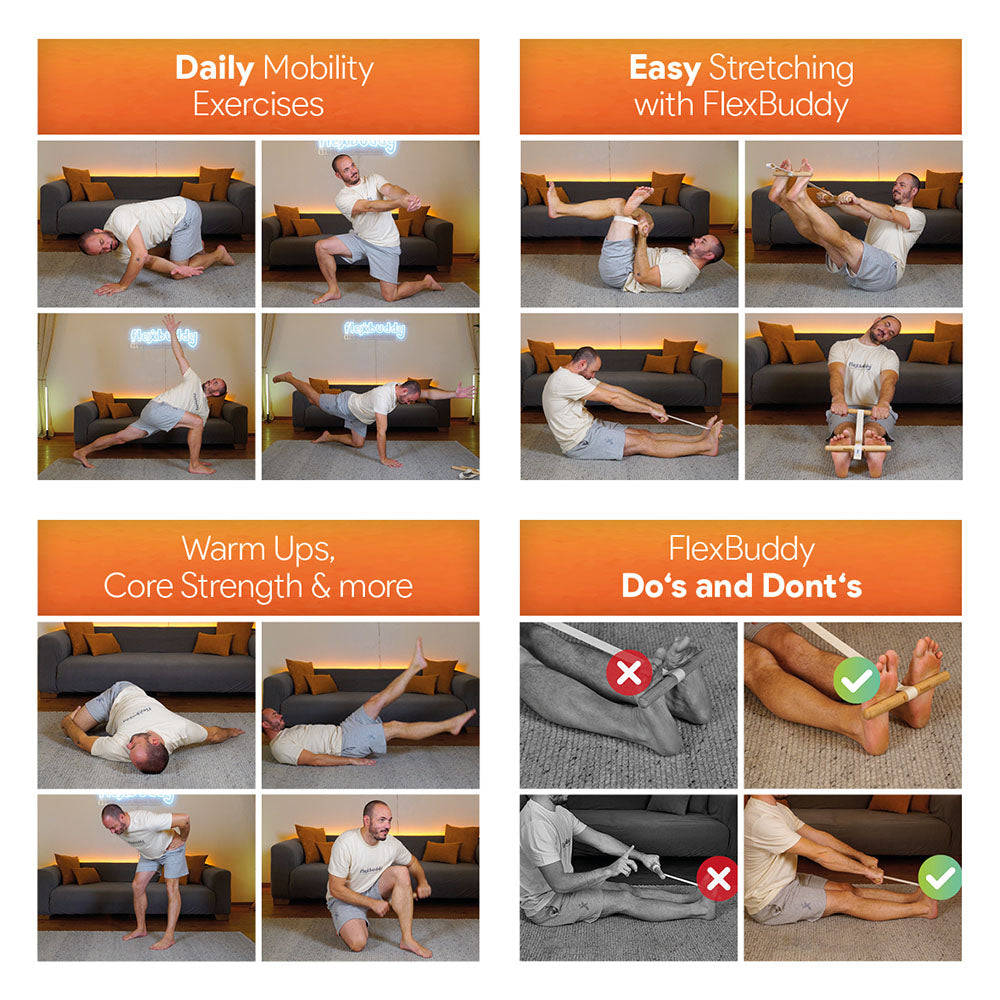
Seated hamstring, straight spine. Sit with both legs out in front. Put the FlexBuddy foot bar under the soles of your feet and hold the other bar in both hands, or loop a strap or towel round your feet. Sit tall, lift the chest and tip the pelvis forward until the backs of the thighs pull. Do not reach for your toes: once the back rounds, the stretch leaves the legs. With FlexBuddy the strap carries the pull, so your back stays long without effort and the stretch lands where it should.
Calf stretch. Face a wall, hands flat on it, and step one foot back. Keep the back knee straight and the heel down, and lean in until the calf pulls. If cramps are why you are here, add a round with the back knee bent, which moves the stretch lower in the calf.
Figure-4, or knee to chest. Lie on your back with knees bent. Cross the right ankle over the left knee, reach through and draw the left thigh towards you until the right buttock feels it. If that is awkward, hug one knee to the chest, hands behind the thigh.
Child's pose, or supported forward lean. Kneel, knees apart, sit back towards your heels and rest your forehead on a pillow. If your knees dislike kneeling, sit on the edge of the bed, put a pillow on your thighs and fold over it. Let the back round: this one is pure rest.
Chest and neck release. Sitting tall, clasp your hands behind your back and draw the shoulder blades together and down until the chest opens. Then drop the right ear towards the right shoulder and let the left shoulder sink, without pulling on the head. Change sides.
The reasoning behind the numbers is in how long to hold a stretch and how often you should stretch.
The 2-minute version, in bed
Some nights you are already lying down. Good: this version is made for exactly that. Keep FlexBuddy on the bedside table and do it on your back.
- Knee to chest, 30 seconds each side. Hands behind the thigh, lower back heavy on the mattress.
- Straight leg up, 30 seconds each side. Foot bar under the sole, raise the leg with the knee straight until the back of the thigh pulls, then draw the toes towards you so the calf joins in. Hamstring and calf together: the two muscles from the cramp trial [2].
Two minutes, eyes closed, and you are already where you want to fall asleep. The full five-minute wind-down, with versions for a sore back and sciatica, is in stretches you can do in bed. If two minutes is all you ever have, the two-minute daily routine shows how much that still does.
How to breathe while you stretch
In through the nose for a count of four, out for a count of six. That is six breaths a minute, the pace used in many slow-breathing studies [14].
The long exhale is the part that matters. When people breathed slowly with either a long or a short exhale, the long exhale left them more relaxed and raised their parasympathetic activity [16].
And it carries over into the night. Young adults who did 15 minutes of slow breathing every evening for 30 days rated their sleep quality better than a group who spent the same 15 minutes on social media [17]. Sleep laboratories are now studying slow breathing before sleep as well [18]. You get the same breathing for free inside every stretch of this routine.
What to avoid in the last hour before bed
Hard stretching. A stretch pushed into pain makes you brace and hold your breath. Gentle is what works here, and gentle feels better anyway.
A hard workout in the final hour. Evening exercise is fine: a meta-analysis of 23 studies found that it did not harm sleep and slightly increased deep sleep. Only vigorous exercise ending within an hour of bedtime got in the way [19]. Slow stretching is the ideal thing to do in that last hour.
Caffeine, alcohol, screens and late meals. The NHS says no tea, coffee or alcohol in the six hours before bed, no big meal late at night, and no television or phones right before bed, because the blue light keeps you awake [7]. Swap the last seven minutes of screen for the routine and you fix two things at once.
Is it better to stretch in the morning or at night?
Night is when your body is ready for it. You are more flexible in the evening: sit-and-reach scores were higher at 6 pm than at 8 am [20]. Your spine handles bending far better too. Researchers estimated that a forward bend early in the morning puts about 300 per cent more bending stress on the discs than the same bend later in the day [21]. So the deep forward-leaning stretches belong in the evening, which is exactly where this routine puts them.
Mornings are for gentle movement: our morning stretching routine is built for that. The guideline counts days per week, not times of day [4], so do both if you can: a few easy minutes after waking, and the deeper, slower holds at night.
How to make it stick
Habits form when a simple action is repeated in the same place at the same moment until it runs without a decision, and the most reliable trigger is something you already do every day [22]. You have one: brushing your teeth. Teeth, then stretch.
In the research behind that advice, a daily action took an average of 66 days to feel automatic, and missing one day did no lasting harm [22]. Leave FlexBuddy beside the bed where you cannot miss it, put the phone on charge out of reach, and on tired nights do the two-minute version. Give it a week and you will not want to go to bed without it.
When poor sleep needs a doctor
If you have had trouble sleeping for months, or it makes daily life hard to cope with, see a GP: there are effective treatments such as cognitive behavioural therapy, and a sleep clinic can check for conditions such as sleep apnoea [7]. Keep stretching alongside whatever they recommend. It fits with all of it.

Do it properly with FlexBuddy
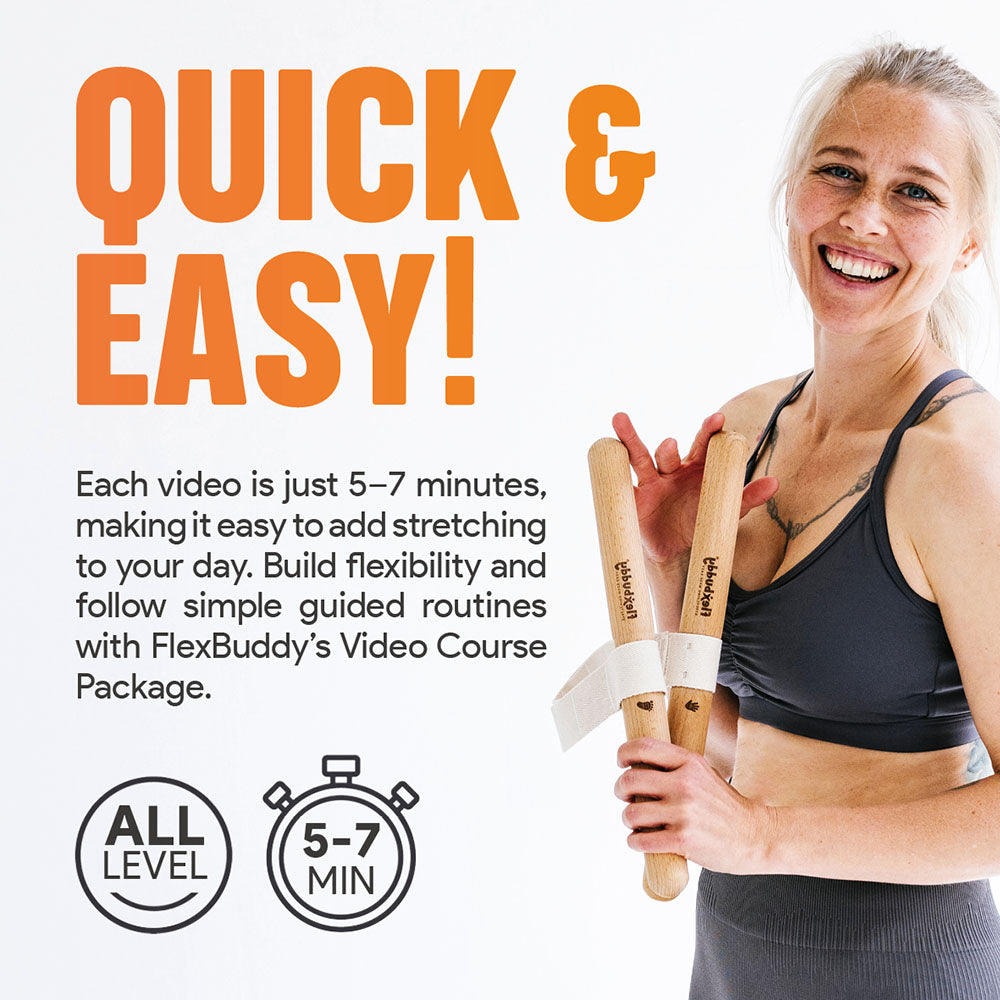
The seated hamstring stretch is the heart of this routine, and at the end of the day it is the hardest one to do well: you are tired, your back slumps, and the stretch never reaches your legs. FlexBuddy® solves that. It is a patented stretching device made of two beech-wood bars joined by an adjustable cotton strap. One bar goes under your feet, the other in your hands. You sit tall, tilt the hips forward, and the strap carries the pull while your hamstrings and calves let go together. Comfortable wooden handles, no rope burn, one size for every body.
It works lying down for the two-minute version, and kept by the bed it becomes the reminder you see after brushing your teeth. Sara F. wrote: "I use it before I go to bed and if I don't, I can really tell a difference in the morning." Two minutes a day can improve your flexibility and posture. It is rated 4.5 by verified buyers and comes with a 30-day money-back guarantee and a lifetime warranty, so you can try it without risk. Get your FlexBuddy, or take the two-minute quiz to see where you start.
Frequently asked questions
Is it good to stretch before bed?
Yes. It is one of the best things you can do in the last ten minutes of the day. Regular stretching improved sleep in adults with insomnia and in older adults who slept badly [1][11], and it leaves your body loose and your breathing slow, ready for sleep.
Does stretching before bed help you sleep?
Yes. In a four-month trial, adults with chronic insomnia who stretched regularly cut their insomnia score by about 8 points, fell asleep faster and woke less in the night [1]. You will feel the calming effect from the first night.
What stretches should I do before bed?
A straight-spine seated hamstring stretch, a wall calf stretch, a figure-4 or knee to chest, child's pose or a supported forward lean, and a chest and neck release. Hold each for 30 seconds and breathe out slowly. FlexBuddy makes the first one easy to do well.
How long should I stretch before bed?
Six to eight minutes covers all five stretches at 30 seconds a hold [4][5]. Ten minutes a night was enough to lift mood in three weeks in one trial [9]. On a tired night, two minutes in bed keeps the habit alive.
Does stretching before bed stop leg cramps?
It cuts them down. In a trial of adults over 55, nightly calf and hamstring stretching before sleep meant 1.2 fewer cramps per night within six weeks, and milder ones [2]. A Cochrane review supports it for cramp severity [3].
Is it better to stretch in the morning or at night?
Night is best for deep holds: you are more flexible in the evening [20] and your spine takes bending far better than early in the morning [21]. Keep mornings gentle. A short version of both is ideal.
This article is general information, not medical advice. Tight muscles usually respond well to regular stretching. If your pain is sharp, radiates down a leg, comes with numbness, weakness, fever, bladder or bowel changes, follows an injury, or keeps getting worse, see a doctor or physiotherapist before you stretch.
References
- D'Aurea CVR, Poyares D, Passos GS, et al. Effects of resistance exercise training and stretching on chronic insomnia. Braz J Psychiatry. 2019;41(1):51–57. doi:10.1590/1516-4446-2018-0030. PMID 30328967; PMC6781703 (full text accessed 10 Nov 2026).
- Hallegraeff JM, van der Schans CP, de Ruiter R, de Greef MH. Stretching before sleep reduces the frequency and severity of nocturnal leg cramps in older adults: a randomised trial. J Physiother. 2012;58(1):17–22. doi:10.1016/S1836-9553(12)70068-1. PMID 22341378 (abstract accessed 10 Nov 2026).
- Hawke F, Sadler SG, Katzberg HD, Pourkazemi F, Chuter V, Burns J. Non-drug therapies for the secondary prevention of lower limb muscle cramps. Cochrane Database Syst Rev. 2021;5(5):CD008496. doi:10.1002/14651858.CD008496.pub3. PMID 33998664; PMC8127570. Update of: Blyton F, Chuter V, Walter KE, Burns J. Non-drug therapies for lower limb muscle cramps. Cochrane Database Syst Rev. 2012;1:CD008496. PMID 22258986 (accessed 10 Nov 2026).
- Garber CE, Blissmer B, Deschenes MR, et al.; American College of Sports Medicine. Position stand: quantity and quality of exercise for developing and maintaining cardiorespiratory, musculoskeletal, and neuromotor fitness in apparently healthy adults. Med Sci Sports Exerc. 2011;43(7):1334–1359. doi:10.1249/MSS.0b013e318213fefb. PMID 21694556 (abstract accessed 10 Nov 2026).
- Page P. Current concepts in muscle stretching for exercise and rehabilitation. Int J Sports Phys Ther. 2012;7(1):109–119. PMC3273886. https://pmc.ncbi.nlm.nih.gov/articles/PMC3273886/ (accessed 10 Nov 2026).
- Laborde S, Allen MS, Borges U, et al. Effects of voluntary slow breathing on heart rate and heart rate variability: a systematic review and a meta-analysis. Neurosci Biobehav Rev. 2022;138:104711. doi:10.1016/j.neubiorev.2022.104711. PMID 35623448 (abstract accessed 10 Nov 2026).
- NHS. Insomnia. Page last reviewed 19 Mar 2024. https://www.nhs.uk/conditions/insomnia/ (accessed 10 Nov 2026).
- NHS. Restless legs syndrome. Page last reviewed 22 Sep 2025. https://www.nhs.uk/conditions/restless-legs-syndrome/ (accessed 10 Nov 2026).
- Kai Y, Nagamatsu T, Kitabatake Y, Sensui H. Effects of stretching on menopausal and depressive symptoms in middle-aged women: a randomized controlled trial. Menopause. 2016;23(8):827–832. doi:10.1097/GME.0000000000000651. PMID 27300113; PMC4961267 (full text accessed 10 Nov 2026).
- Tworoger SS, Yasui Y, Vitiello MV, et al. Effects of a yearlong moderate-intensity exercise and a stretching intervention on sleep quality in postmenopausal women. Sleep. 2003;26(7):830–836. doi:10.1093/sleep/26.7.830. PMID 14655916 (abstract accessed 10 Nov 2026).
- Pa J, Goodson W, Bloch A, King AC, Yaffe K, Barnes DE. Effect of exercise and cognitive activity on self-reported sleep quality in community-dwelling older adults with cognitive complaints: a randomized controlled trial. J Am Geriatr Soc. 2014;62(12):2319–2326. doi:10.1111/jgs.13158. PMID 25516028; PMC4356237 (full text accessed 10 Nov 2026).
- Kredlow MA, Capozzoli MC, Hearon BA, Calkins AW, Otto MW. The effects of physical activity on sleep: a meta-analytic review. J Behav Med. 2015;38(3):427–449. doi:10.1007/s10865-015-9617-6. PMID 25596964 (abstract accessed 10 Nov 2026).
- Wong A, Figueroa A. Effects of acute stretching exercise and training on heart rate variability: a review. J Strength Cond Res. 2021;35(5):1459–1466. doi:10.1519/JSC.0000000000003084. PMID 30789584 (abstract accessed 10 Nov 2026).
- Zaccaro A, Piarulli A, Laurino M, et al. How breath-control can change your life: a systematic review on psycho-physiological correlates of slow breathing. Front Hum Neurosci. 2018;12:353. doi:10.3389/fnhum.2018.00353. PMID 30245619; PMC6137615 (full text accessed 10 Nov 2026).
- NHS. Leg cramps. Page last reviewed 1 Dec 2023. https://www.nhs.uk/conditions/leg-cramps/ (accessed 10 Nov 2026).
- Van Diest I, Verstappen K, Aubert AE, Widjaja D, Vansteenwegen D, Vlemincx E. Inhalation/exhalation ratio modulates the effect of slow breathing on heart rate variability and relaxation. Appl Psychophysiol Biofeedback. 2014;39(3-4):171–180. doi:10.1007/s10484-014-9253-x. PMID 25156003 (abstract accessed 10 Nov 2026).
- Laborde S, Hosang T, Mosley E, Dosseville F. Influence of a 30-day slow-paced breathing intervention compared to social media use on subjective sleep quality and cardiac vagal activity. J Clin Med. 2019;8(2):193. doi:10.3390/jcm8020193. PMID 30736268; PMC6406675 (abstract accessed 10 Nov 2026).
- Kuula L, Halonen R, Kajanto K, et al. The effects of presleep slow breathing and music listening on polysomnographic sleep measures: a pilot trial. Sci Rep. 2020;10(1):7427. doi:10.1038/s41598-020-64218-7. PMID 32366866; PMC7198497 (abstract accessed 10 Nov 2026).
- Stutz J, Eiholzer R, Spengler CM. Effects of evening exercise on sleep in healthy participants: a systematic review and meta-analysis. Sports Med. 2019;49(2):269–287. doi:10.1007/s40279-018-1015-0. PMID 30374942 (abstract accessed 10 Nov 2026).
- Guariglia DA, Pereira LM, Dias JM, et al. Time-of-day effect on hip flexibility associated with the modified sit-and-reach test in males. Int J Sports Med. 2011;32(12):947–952. doi:10.1055/s-0031-1283182. PMID 22052023 (abstract accessed 10 Nov 2026).
- Adams MA, Dolan P, Hutton WC. Diurnal variations in the stresses on the lumbar spine. Spine. 1987;12(2):130–137. doi:10.1097/00007632-198703000-00008. PMID 3589804 (abstract accessed 10 Nov 2026).
- Gardner B, Lally P, Wardle J. Making health habitual: the psychology of 'habit-formation' and general practice. Br J Gen Pract. 2012;62(605):664–666. doi:10.3399/bjgp12X659466. PMC3505409. https://pmc.ncbi.nlm.nih.gov/articles/PMC3505409/ (accessed 10 Nov 2026).