- Stretching makes you move further. One bout increases your range of motion straight away [1], and regular static or PNF stretching makes the gain last [2].
- Warm up by moving and you perform better. Performance was 1.3% higher after dynamic stretching [1]. Short static holds inside a full warm-up cost nothing in sprint or jump tests [3]. Just keep them under 60 seconds per muscle before maximal efforts.
- After sport is the best time to build range. Your muscles are warm and there is no performance left to protect. Soreness eases a little as well: in a field trial of 2,377 people, stretching before and after activity lowered peak soreness over the week [4].
- Strong and supple beats either alone. Strength training cut sports injuries to about a third (relative risk 0.32) [5], and early evidence points to static stretching reducing muscle injuries [6].
- Want more range? Give it its own session: warm, static or PNF, at least 60 seconds per muscle group on at least two days a week [7].
- Range lasts when strength backs it up. Eccentric training improves flexibility as well as strength [8].
- FlexBuddy® is your two-minute finisher. After training it stretches hamstrings and calves together while your spine stays straight, and it fits in your backpack.
What stretching does for an athlete
Athletes stretch to move further, to perform better and to keep their muscles out of trouble. Used at the right moment, stretching helps with all three. The only skill is knowing which kind to use and when, and this guide gives you exactly that.
The big win: range of motion
One bout of stretching, whether static, dynamic or PNF (a hold with a muscle contraction built in), increases joint range of motion straight away [1]. Repeat it over weeks and the gain stays. The largest analysis so far pooled 77 studies and 186 effect sizes in healthy people and found a moderate overall increase in range, with static and PNF stretching producing larger gains than ballistic or dynamic stretching [2].
More range means a longer stride, a deeper squat, a higher kick and a body that gets into position without a fight.
What the experts recommend
In 2025 a panel of 20 stretching researchers worked through the systematic reviews and voted on practical recommendations, with at least 80% agreement required for each. Their verdict: stretch for range of motion, short term and long term [6]. Stretching is the tool for range: use it when and where range is what you need.
Should you stretch before a workout?
Yes: by moving first, with short holds where you want them. Get the dose right and you only gain.
Static holds before sprinting, jumping and lifting: keep them short
Three large reviews agree on the rule, and it is an easy one to follow. Static stretching straight before a maximal effort takes a little off the top: across 104 studies, stretching immediately before testing reduced maximal strength by 5.4% on average, power by 1.9% and explosive performance such as sprints and jumps by 2.0%, with the smallest losses when the stretch lasted 45 seconds or less [9]. Short holds are fine: a systematic review of 106 studies found no detrimental effect from holds under 30 seconds and no significant effect at 30 to 45 seconds [10]. A 2016 review drew the line at 60 seconds per muscle group: stay under it and the average cost was 1.1%, go over it and the cost was 4.6% [1].
A real warm-up wipes out even that. When dynamic activity followed the stretch, as it does in any proper warm-up, no clear effect on performance remained [1]. And when male team-sport athletes did a full warm-up containing a 5-second static stretch, a 30-second static stretch, dynamic stretching or no stretching at all, they sprinted, jumped and changed direction just as well every time [3].
So stretch that tight calf before five-a-side with a clear conscience. Save the two-minute hamstring holds for after the session, where they do the most good. The 2025 panel puts it in one rule: no static stretching beyond 60 seconds per muscle before maximal or explosive efforts [6].
What a dynamic warm-up does for you
Dynamic stretching means moving a joint through its range under control, with no hold: leg swings, walking lunges, arm circles, high knees. It makes you sharper on the spot: measured immediately afterwards, performance was 1.3% higher on average after dynamic stretching [1]. A 2018 review found substantial evidence for gains in range of motion and in the force, power, sprint and jump performance that follows. The extra range comes mainly from reduced stiffness of the muscle-tendon unit; the performance gain from higher muscle temperature and the potentiating effect of the contractions themselves. Controlled movement works better than fast bouncing [11].
A warm-up that fits most sports has three parts, in the order the research trials use [12]:
- Raise your temperature. Easy running, cycling, rowing or skipping until you are warm and breathing harder. The NHS basic warm-up takes at least six minutes [13].
- Dynamic drills for the joints you are about to use. Leg swings, lunges, hip circles, arm circles, trunk rotations, with the range growing on each repetition.
- The sport itself at rising intensity. Build-up sprints, lighter sets of the lift, easy rallies, a few throws or serves.
The definitions, the drills and the full comparison are in static vs dynamic stretching.
When static stretching before sport gives you an edge
Some sports are won at the end of the range. A gymnast's split leap, a dancer's arabesque, a head-height kick in taekwondo, a hurdler's lead leg: none can be performed unless the range is available on the day. For athletes who need flexibility for their sport, such as gymnasts and dancers, the evidence points to static stretching in the warm-up as the more useful choice, while athletes who mainly run and jump are better served by dynamic work [14]. The 2016 review measured the benefit: static stretching improved performance by 2.2% on average when it was tested at longer muscle lengths [1].
The practical version for end-range sports:
- Do the general warm-up first, so the muscle is warm before you hold it.
- Keep each hold short and the total under 60 seconds per muscle group [10][12].
- Follow the holds with dynamic drills and sport-specific movement before anything maximal [1].
- Build the range in separate sessions (see below), so pre-competition holds only reach a range you already own.
Outside those sports, one short hold on a muscle that feels like a brake is worth having. In the crossover trial above, athletes rated the warm-up as more effective with stretching of any kind (5.3 to 6.4 out of 10, against 4.0 without) [3]. Feeling ready is part of being ready.
Should you stretch after a workout?
Yes. This is where static stretching belongs and where it pays best.
Does stretching after a workout reduce soreness?
A little, and that is the smallest of its benefits. The Cochrane review on stretching and delayed-onset muscle soreness, the ache that arrives the day after hard or unfamiliar exercise, included 12 randomised studies. One of them was a field trial of 2,377 people, in which stretching before and after activity lowered peak soreness over a week by about four points out of 100, a statistically significant drop [4].
That field trial also reported its result a second way: over 12 weeks, 24.6% of the stretching group reported bothersome soreness in an average week, against 32.3% of the control group [15]. And the minutes on the floor cost your recovery nothing: in a 2021 meta-analysis, strength came back just as well after post-exercise stretching as after simply resting [16].
What post-session stretching is best for
- Range. The muscles are warm, there is no performance left to protect, and static stretching is the type that builds lasting range [2].
- Routine. Stretching attached to the end of training gets done. Two sessions a week already meet the guideline minimum [7].
- Calming down. A few quiet minutes of slow breathing on the floor is the best way to end a session. The 2025 panel found no sign that it harms recovery [6], so enjoy it.
The dose is small: holds of 15 to 30 seconds, two to four per muscle [14], which adds up to about the 60 seconds per muscle-tendon group that the American College of Sports Medicine recommends [7]. This is the moment for FlexBuddy: sit tall with the foot bar under your soles, and hamstrings and calves get their stretch together in about two minutes. Hold times by goal are in how long to hold a stretch; the roller-or-mat question is in foam rolling vs stretching.
Does stretching prevent injury?
For muscle strains, the evidence is on your side. For everything else, add strength and you are covered twice.
Where stretching does its work: muscles and tendons
Few questions in sport have been studied harder: there is a systematic review of the injury literature [17], a trial in 1,538 male army recruits [18] and a Cochrane review of running injuries [19]. The clearest result comes from a trial of 2,377 active adults: stretching reduced injuries to muscles, ligaments and tendons, 0.66 per person-year against 0.88 (hazard ratio 0.75) [15]. A 2010 review concluded that there is evidence stretching reduces muscle strains [20]. The overall injury count is the job of strength and balance training, which comes next.
Your sport decides how much this matters to you. One explanation, proposed in 2004: sports built on sprinting, jumping and bouncing, such as soccer and American football, load the muscle-tendon unit with intense stretch-shortening cycles, and a more compliant unit copes better with them [21]. The 2025 panel reads it the same way: early evidence points to static stretching reducing muscle injuries [6].
For a sprinter or a footballer, that is a good reason to keep hamstring, quadriceps and calf stretching in the week, every week. Then add the heavy hitter.
The other half of staying fit to play: strength and neuromuscular training
A meta-analysis of 25 trials with 26,610 participants and 3,464 injuries sorted prevention programmes by type. Proprioception (balance) training came out at a relative risk of 0.55, programmes combining several components at 0.66, and strength training at 0.32: fewer than a third of the injuries [5]. A follow-up restricted to strength training (six trials, 7,738 participants aged 12 to 40) put the figure at 0.34 and found a dose-response: a 10% increase in strength training volume lowered injury risk by more than four percentage points [22].
Two programmes are worth knowing by name:
- The Nordic hamstring exercise. Kneel with your ankles held and lower your straight body towards the floor as slowly as you can. In a randomised trial of 579 male amateur footballers from 40 teams, 25 sessions over 13 weeks cut hamstring injuries from 0.8 to 0.25 per 1,000 player-hours [23]. Across 15 studies and 8,459 athletes in several sports, programmes that included it halved hamstring injuries (risk ratio 0.49) [24].
- FIFA 11+. In four cluster-randomised trials in recreational and sub-elite football, this exercise-based warm-up programme reduced injuries overall by 39% [25].
Warm-ups built on dynamic activity, with some dynamic stretching inside them, also show consistently positive effects on injury rates [26]. The winning order follows: get strong, warm up with movement, and stretch for the range your sport needs.
Stretching by sport: where range runs out, what to do before and after
This table is practical guidance drawn from what each sport asks of the body rather than from trials. "Before" follows the warm-up rules above, "after" the post-session dose of 15 to 30 seconds, two to four times per muscle [14].
| Sport | Where range usually runs out | Before | After |
|---|---|---|---|
| Running | Calves and ankles, hamstrings, hip flexors, glutes | Easy jog, leg swings, walking lunges, calf pumps, build-up strides | Calves (knee straight, then bent), hamstrings with a long spine (FlexBuddy does both at once), hip flexors, glutes. Full routine: stretching for runners |
| Cycling | Hip flexors and quadriceps (the hip never fully opens on the bike), hamstrings, lower and upper back, chest, neck | Easy spinning, then a few short harder efforts | Hip flexors, quadriceps, hamstrings with FlexBuddy, chest opener, upper-back extension. Full routine: stretching for cyclists |
| Football (soccer) and field sports | Hamstrings, adductors (groin), hip flexors, quadriceps, calves | A structured, exercise-based warm-up [25], then sprints and ball work. Short static holds are fine early on | Hamstrings and calves with FlexBuddy, adductors, hip flexors. Nordic hamstring exercise inside the training week [23] |
| Weightlifting and gym training | Ankles (deep squat), hips, upper back and shoulders (overhead positions), lats, chest | Light sets of the lift through its full range, drills for ankles, hips and upper back. No long static holds before heavy sets [10] | Whatever limited your positions: calves, hip flexors, lats, chest |
| Racket sports | Hitting shoulder, trunk rotation, hips and adductors (wide lunges), calves, forearms | Jog and side shuffles, lunges with rotation, arm circles, shadow swings, serves building to full pace | Calves, adductors, hip flexors, back of the shoulder, chest, forearms |
| Swimming | Shoulders, lats and chest, upper-back extension and rotation, ankles (pointing the foot), hip flexors | Arm swings and trunk rotations on deck, then easy lengths building speed | Lats, chest, hip flexors, calves, front of the ankle |
| Golf | Hip rotation, upper-back rotation, shoulders, hamstrings (the address position), wrists | Brisk walk, trunk rotations, hip circles, practice swings from half to full speed | Glutes and hip rotators (figure-four), hip flexors, hamstrings, upper-back rotation |
Hamstrings or calves turn up in every row, which is why FlexBuddy earns its place in any kit bag. If your limit is the ankle, with a heel that lifts in the squat, that joint has its own guide: ankle mobility.
The separate flexibility session: when range itself is the goal
A few minutes after training keeps your range. If you want more of it (the splits for a martial artist, a deeper squat, hurdle clearance), give flexibility its own session, away from anything that needs power.
- When. A rest day, an evening, or straight after an easy session. Never directly before maximal efforts: long holds belong here, well away from them [10].
- Warm. The American College of Sports Medicine recommends that static stretching follows an active warm-up [14]. A few minutes of brisk walking, cycling or skipping is enough.
- Type. Static or PNF, the two with the largest lasting gains [2].
- Dose. The guideline minimum is a total of 60 seconds per muscle-tendon group on at least two days a week [7], usually done as holds of 15 to 30 seconds repeated two to four times, two to three days a week [14]. For maximum range, the 2025 panel goes further: two to three sets a day, each held 30 to 120 seconds per muscle [6].
- Intensity. Firm tension, never pain. For immediate range gains, low-intensity and high-intensity stretching did not differ significantly [6], so gentle works just as well as forcing.
The best news is in the 77-study analysis: neither volume, intensity nor weekly frequency significantly predicted the gain [2]. You do not have to suffer or live on the mat. Showing up is what counts, so pick a dose you will still be doing in three months. See how often should you stretch.
A base session, each stretch held 30 seconds, two to three times per side, which reaches the 60-second total [7]. Swap rows for your sport:
| Stretch | Position |
|---|---|
| Seated hamstring stretch | Legs straight, FlexBuddy foot bar under the soles (or a strap around the feet), spine long, chest up, tip the pelvis forward |
| Calf stretch, two versions | Heel down, leaning into a wall: once with the back knee straight, once with it bent |
| Half-kneeling hip flexor stretch | Back knee on a cushion, tuck the pelvis under, shift forward until the front of the hip pulls |
| Figure-four glute stretch | On your back, ankle across the opposite knee, draw the lower thigh towards you |
| Butterfly adductor stretch | Seated, soles of the feet together, spine long, hinge forward from the hips. The FlexBuddy strap works as a loop here |
| Doorway chest stretch | Forearm on the door frame, elbow at shoulder height, step through until the chest opens |
Swimmers, lifters and racket players can add the Shoulder Opener from the FlexBuddy video library: hold both handles in front with straight arms, raise the device overhead and slightly behind, lower with control, five to eight slow reps.
Flexibility needs strength to stick
A range you can reach passively on the floor and a range you can use at speed are different things. Train both and the range is yours to keep.
First, strength training through a full range of motion improves range about as well as stretching does: a meta-analysis of 11 randomised trials with 452 participants found no significant difference between the two [27]. Deep squats and Romanian deadlifts are flexibility work too.
Second, eccentric training, in which the muscle works while it lengthens (the lowering phase of a Nordic, a slow heel drop off a step), changes the muscle itself. A systematic review of six randomised trials in three muscle groups found consistent, strong evidence that eccentric training improves lower-limb flexibility, measured either as joint range or as fascicle length, the length of the muscle's fibre bundles [8]. An updated meta-analysis of 27 trials and 911 participants put the effect at a moderately large 0.54 standard deviations [28].
So stretch to open the range, then load it: slow lowerings, full-depth lifts, and for anyone who sprints, the eccentric hamstring work that also prevents strains [24].
Programming a week
An example for a club athlete with two sport sessions, one gym session and a match or race.
| Day | Session | Warm-up | Afterwards |
|---|---|---|---|
| Monday | Strength, including eccentric hamstring and calf work | Easy cardio, mobility drills, light sets of each lift | Short stretch: hip flexors, calves, chest |
| Tuesday | Sport training or intervals | Full dynamic warm-up, no long holds | Short stretch: hamstrings and calves with FlexBuddy, quadriceps |
| Wednesday | Rest or easy aerobic work | None needed | Flexibility session 1 |
| Thursday | Sport training | Full dynamic warm-up | Short stretch: hamstrings, adductors, calves |
| Friday | Rest | None needed | Optional short routine, gentle |
| Saturday | Match or race | Full dynamic warm-up. Static holds only where needed, short, followed by movement | A few easy holds to wind down and keep your range |
| Sunday | Rest or easy walk | None needed | Flexibility session 2 |
Three rules sit under the table. Long holds never come directly before maximal efforts [10]. Two flexibility sessions meet the guideline minimum, and the same guideline asks for resistance training on two to three days a week [7], which is also a powerful injury-prevention tool [5]. And the short post-session stretch is for range and habit. Keep FlexBuddy in your kit bag and it takes two minutes, even when time is short. Give it a month and you will feel the difference in every stride.
When tightness is an injury
Tightness is even and dull, usually on both sides, builds over weeks and eases as you warm up. A strain happens in one moment, on one side, typically mid-sprint or mid-kick, and can bring a sharp pain, a pop, bruising or weakness. Stretching helps the first and can set back the second: a freshly strained muscle should not be stretched hard in the first days. The differences, the grades and the return-to-stretching criteria are in pulled hamstring vs tight hamstring.
Stop stretching and have it looked at if a "tight" muscle burns, tingles or goes numb down the limb (that is a nerve, not a muscle), if there is swelling or bruising, or if it keeps getting worse despite rest.

Your two-minute finisher: FlexBuddy
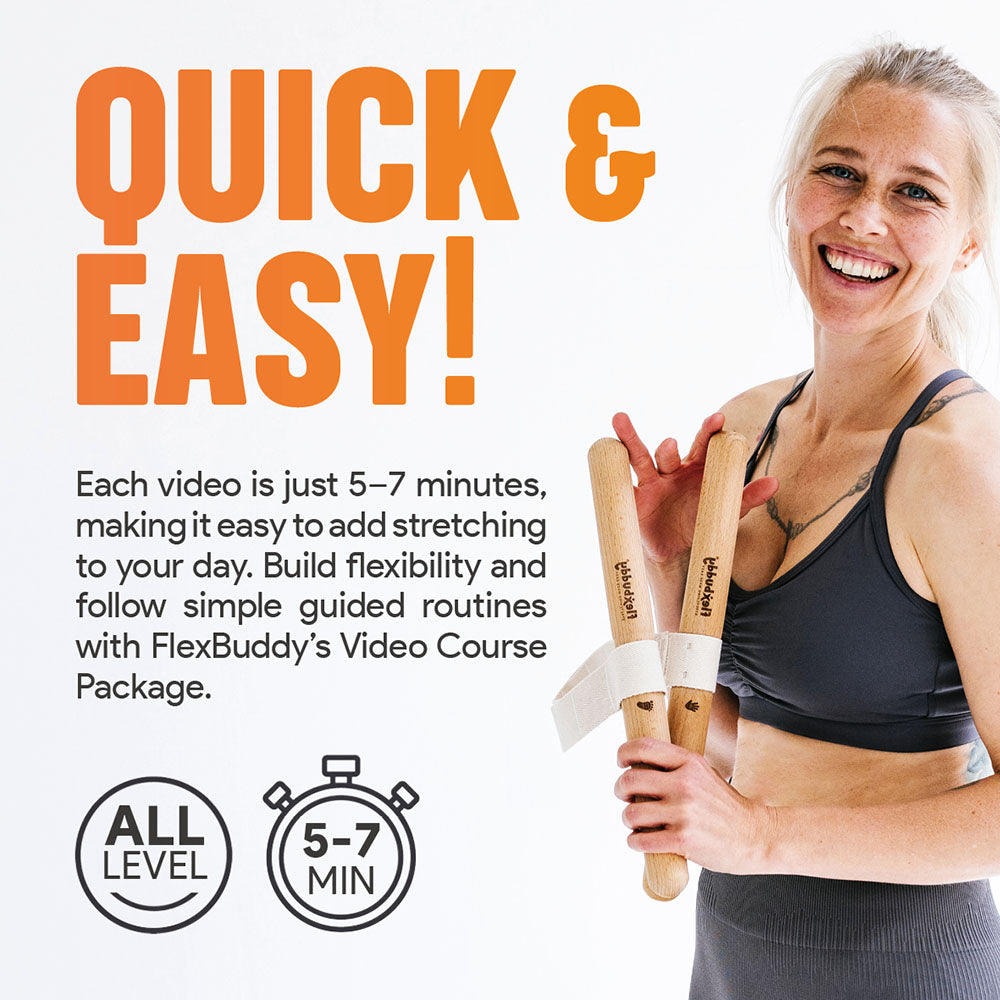
Hamstrings and calves tighten in almost every sport, and the stretch after training is the one that gets skipped. FlexBuddy® makes it too quick and too comfortable to skip. It is a patented stretching device made of two beech-wood bars joined by an adjustable cotton strap: one bar goes under the soles of your feet, the other in your hands. After training, sit tall, lean back and tilt the hips forward. The strap carries the pull, so tired hamstrings and calves get the stretch together while your spine stays neutral and does not round to reach. Ten slow breaths, three times, takes about two minutes. Move the foot bar to another loop for big changes in length, or roll the hand bar for small ones, so a stiff prop forward and a supple winger can share one.
Use it after training and in your flexibility sessions, and it becomes the habit that keeps your range. "A great tool to help your clients maintain a neutral spine while stretching calves, hamstrings and lower back," wrote Scott K., a trainer. Comfortable wooden handles, no rope burn, and it fits in a backpack. FlexBuddy is rated 4.5 by verified buyers and comes with a 30-day money-back guarantee and a lifetime warranty, so you can try it without risk. Get your FlexBuddy, or take the two-minute quiz to find the routine for your kind of stiffness.
Frequently asked questions
Should you stretch before or after a workout?
Both, and each has its job. Before: a dynamic warm-up, which lifts performance [1]. After, or in a separate session: static stretching, the type that builds lasting range [2]. FlexBuddy makes the after part a two-minute job.
Does stretching before exercise prevent injury?
It helps where sprinting sports hurt most: muscles. In a trial of 2,377 active adults, those who stretched had fewer injuries to muscles, ligaments and tendons [15], and early evidence points to static stretching reducing muscle strains [6]. Add strength training, which cut injuries to about a third [5], and you are well covered.
Is static stretching bad before a workout?
No, as long as you keep it short. Inside a full warm-up, short holds made no difference to sprinting or jumping [3]. Stay under 60 seconds per muscle and the average cost is about 1%; 60 seconds or more costs about 4.6% [1].
Does stretching after a workout reduce soreness?
A little, and it gives you much more than that. In a trial of 2,377 active adults, 24.6% of those who stretched reported bothersome soreness in an average week, against 32.3% of those who did not [15]. The bigger wins are lasting range and a calm end to the session.
How long should athletes hold a stretch?
Before sport: under 60 seconds in total per muscle, followed by movement [10]. Afterwards or in a flexibility session: 15 to 30 seconds, two to four times [14]. For maximum range, experts suggest holds of 30 to 120 seconds [6].
Should athletes stretch every day?
Yes, if you want the biggest gains: daily stretching is what the 2025 expert panel suggests for athletes who want the largest gains in range [6]. The guideline minimum is two days a week [7]. Keep long holds away from maximal efforts.
This article is general information, not medical advice. Tight muscles usually respond well to regular stretching. If your pain is sharp, radiates down a leg, comes with numbness, weakness, fever, bladder or bowel changes, follows an injury, or keeps getting worse, see a doctor or physiotherapist before you stretch.
References
- Behm DG, Blazevich AJ, Kay AD, McHugh M. Acute effects of muscle stretching on physical performance, range of motion, and injury incidence in healthy active individuals: a systematic review. Appl Physiol Nutr Metab. 2016;41(1):1–11. doi:10.1139/apnm-2015-0235. PMID 26642915 (abstract accessed 10 Nov 2026).
- Konrad A, Alizadeh S, Daneshjoo A, et al. Chronic effects of stretching on range of motion with consideration of potential moderating variables: a systematic review with meta-analysis. J Sport Health Sci. 2024;13(2):186–194. doi:10.1016/j.jshs.2023.06.002. PMID 37301370; PMC10980866 (abstract accessed 10 Nov 2026).
- Blazevich AJ, Gill ND, Kvorning T, et al. No effect of muscle stretching within a full, dynamic warm-up on athletic performance. Med Sci Sports Exerc. 2018;50(6):1258–1266. doi:10.1249/MSS.0000000000001539. PMID 29300214 (abstract accessed 10 Nov 2026).
- Herbert RD, de Noronha M, Kamper SJ. Stretching to prevent or reduce muscle soreness after exercise. Cochrane Database Syst Rev. 2011;(7):CD004577. doi:10.1002/14651858.CD004577.pub3. PMID 21735398 (abstract accessed 10 Nov 2026).
- Lauersen JB, Bertelsen DM, Andersen LB. The effectiveness of exercise interventions to prevent sports injuries: a systematic review and meta-analysis of randomised controlled trials. Br J Sports Med. 2014;48(11):871–877. doi:10.1136/bjsports-2013-092538. PMID 24100287 (abstract accessed 10 Nov 2026).
- Warneke K, Thomas E, Blazevich AJ, et al. Practical recommendations on stretching exercise: a Delphi consensus statement of international research experts. J Sport Health Sci. 2025;14:101067. doi:10.1016/j.jshs.2025.101067. PMID 40513717; PMC12305623. https://pmc.ncbi.nlm.nih.gov/articles/PMC12305623/ (full text accessed 10 Nov 2026).
- Garber CE, Blissmer B, Deschenes MR, et al.; American College of Sports Medicine. Position stand: quantity and quality of exercise for developing and maintaining cardiorespiratory, musculoskeletal, and neuromotor fitness in apparently healthy adults: guidance for prescribing exercise. Med Sci Sports Exerc. 2011;43(7):1334–1359. doi:10.1249/MSS.0b013e318213fefb. PMID 21694556 (abstract accessed 10 Nov 2026).
- O'Sullivan K, McAuliffe S, DeBurca N. The effects of eccentric training on lower limb flexibility: a systematic review. Br J Sports Med. 2012;46(12):838–845. doi:10.1136/bjsports-2011-090835. PMID 22522590 (abstract accessed 10 Nov 2026).
- Simic L, Sarabon N, Markovic G. Does pre-exercise static stretching inhibit maximal muscular performance? A meta-analytical review. Scand J Med Sci Sports. 2013;23(2):131–148. doi:10.1111/j.1600-0838.2012.01444.x. PMID 22316148 (abstract accessed 10 Nov 2026).
- Kay AD, Blazevich AJ. Effect of acute static stretch on maximal muscle performance: a systematic review. Med Sci Sports Exerc. 2012;44(1):154–164. doi:10.1249/MSS.0b013e318225cb27. PMID 21659901 (abstract accessed 10 Nov 2026).
- Opplert J, Babault N. Acute effects of dynamic stretching on muscle flexibility and performance: an analysis of the current literature. Sports Med. 2018;48(2):299–325. doi:10.1007/s40279-017-0797-9. PMID 29063454 (abstract accessed 10 Nov 2026).
- Chaabene H, Behm DG, Negra Y, Granacher U. Acute effects of static stretching on muscle strength and power: an attempt to clarify previous caveats. Front Physiol. 2019;10:1468. doi:10.3389/fphys.2019.01468. PMID 31849713; PMC6895680. https://pmc.ncbi.nlm.nih.gov/articles/PMC6895680/ (full text accessed 10 Nov 2026).
- NHS. How to warm up before exercising. Page last reviewed 24 June 2026. https://www.nhs.uk/live-well/exercise/how-to-warm-up-before-exercising/ (accessed 10 Nov 2026).
- Page P. Current concepts in muscle stretching for exercise and rehabilitation. Int J Sports Phys Ther. 2012;7(1):109–119. PMID 22319684; PMC3273886. https://pmc.ncbi.nlm.nih.gov/articles/PMC3273886/ (full text accessed 10 Nov 2026).
- Jamtvedt G, Herbert RD, Flottorp S, et al. A pragmatic randomised trial of stretching before and after physical activity to prevent injury and soreness. Br J Sports Med. 2010;44(14):1002–1009. doi:10.1136/bjsm.2009.062232. PMID 19525241 (abstract accessed 10 Nov 2026).
- Afonso J, Clemente FM, Nakamura FY, et al. The effectiveness of post-exercise stretching in short-term and delayed recovery of strength, range of motion and delayed onset muscle soreness: a systematic review and meta-analysis of randomized controlled trials. Front Physiol. 2021;12:677581. doi:10.3389/fphys.2021.677581. PMID 34025459; PMC8133317 (abstract accessed 10 Nov 2026).
- Thacker SB, Gilchrist J, Stroup DF, Kimsey CD Jr. The impact of stretching on sports injury risk: a systematic review of the literature. Med Sci Sports Exerc. 2004;36(3):371–378. doi:10.1249/01.mss.0000117134.83018.f7. PMID 15076777 (abstract accessed 10 Nov 2026).
- Pope RP, Herbert RD, Kirwan JD, Graham BJ. A randomized trial of preexercise stretching for prevention of lower-limb injury. Med Sci Sports Exerc. 2000;32(2):271–277. doi:10.1097/00005768-200002000-00004. PMID 10694106 (abstract accessed 10 Nov 2026).
- Yeung SS, Yeung EW, Gillespie LD. Interventions for preventing lower limb soft-tissue running injuries. Cochrane Database Syst Rev. 2011;(7):CD001256. doi:10.1002/14651858.CD001256.pub2. PMID 21735382 (abstract accessed 10 Nov 2026).
- McHugh MP, Cosgrave CH. To stretch or not to stretch: the role of stretching in injury prevention and performance. Scand J Med Sci Sports. 2010;20(2):169–181. doi:10.1111/j.1600-0838.2009.01058.x. PMID 20030776 (abstract accessed 10 Nov 2026).
- Witvrouw E, Mahieu N, Danneels L, McNair P. Stretching and injury prevention: an obscure relationship. Sports Med. 2004;34(7):443–449. doi:10.2165/00007256-200434070-00003. PMID 15233597 (abstract accessed 10 Nov 2026).
- Lauersen JB, Andersen TE, Andersen LB. Strength training as superior, dose-dependent and safe prevention of acute and overuse sports injuries: a systematic review, qualitative analysis and meta-analysis. Br J Sports Med. 2018;52(24):1557–1563. doi:10.1136/bjsports-2018-099078. PMID 30131332 (abstract accessed 10 Nov 2026).
- van der Horst N, Smits DW, Petersen J, Goedhart EA, Backx FJ. The preventive effect of the Nordic hamstring exercise on hamstring injuries in amateur soccer players: a randomized controlled trial. Am J Sports Med. 2015;43(6):1316–1323. doi:10.1177/0363546515574057. PMID 25794868 (abstract accessed 10 Nov 2026).
- van Dyk N, Behan FP, Whiteley R. Including the Nordic hamstring exercise in injury prevention programmes halves the rate of hamstring injuries: a systematic review and meta-analysis of 8459 athletes. Br J Sports Med. 2019;53(21):1362–1370. doi:10.1136/bjsports-2018-100045. PMID 30808663 (abstract accessed 10 Nov 2026).
- Thorborg K, Krommes KK, Esteve E, Clausen MB, Bartels EM, Rathleff MS. Effect of specific exercise-based football injury prevention programmes on the overall injury rate in football: a systematic review and meta-analysis of the FIFA 11 and 11+ programmes. Br J Sports Med. 2017;51(7):562–571. doi:10.1136/bjsports-2016-097066. PMID 28087568 (abstract accessed 10 Nov 2026).
- Behm DG, Alizadeh S, Daneshjoo A, Konrad A. Potential effects of dynamic stretching on injury incidence of athletes: a narrative review of risk factors. Sports Med. 2023;53(7):1359–1373. doi:10.1007/s40279-023-01847-8. PMID 37162736; PMC10289929 (abstract accessed 10 Nov 2026).
- Afonso J, Ramirez-Campillo R, Moscão J, et al. Strength training versus stretching for improving range of motion: a systematic review and meta-analysis. Healthcare (Basel). 2021;9(4):427. doi:10.3390/healthcare9040427. PMID 33917036; PMC8067745 (abstract accessed 10 Nov 2026).
- Diong J, Carden PC, O'Sullivan K, Sherrington C, Reed DS. Eccentric exercise improves joint flexibility in adults: a systematic review update and meta-analysis. Musculoskelet Sci Pract. 2022;60:102556. doi:10.1016/j.msksp.2022.102556. PMID 35390669 (abstract accessed 10 Nov 2026).