- You lose far less than you think. Between the 20 to 44 and the 45 to 69 age groups, healthy hips and shoulders give up only 3 to 5 degrees [1], then roughly 6 degrees a decade from 55 to 86 [2]. Only hip extension loses more than a fifth of its arc [3].
- Age gets too much of the blame. In adults aged 20 to 79, hamstring length did not change with age [4], and a substantial loss of movement before 74 counts as abnormal and worth treating [3].
- You can win it back at any age. In trials of older adults, some in their nineties, six to eight weeks of stretching added 12 to 17 degrees of range [5][6][7], and a 2024 analysis of 77 studies found that age made no difference to the size of the gain [8].
- The method is simple. Hold for 30 to 60 seconds, go gentler, warm up first, stretch little and often [5][9]. The routine below covers six areas in 8 to 10 minutes, seated, standing or in bed.
- Add balance and strength to stay steady. Balance and functional exercise cuts the rate of falls by 24% [10]. Osteoporosis, a joint replacement or dizziness change which stretches you choose, not whether you stretch.
- FlexBuddy® does the hard part for you. It keeps your back straight while your hamstrings and calves lengthen, so the hardest stretch becomes the easy one.
What changes after 50: less than you fear
The good news first: the numbers are small and the slope is slow.
Joint range: a gentle slope
In the best reference data, a US study of healthy people aged 2 to 69, average hip flexion (knee towards chest) fell by only about 3 degrees between the 20 to 44 group and the 45 to 69 group, and shoulder flexion (arm overhead) by 4 to 5 degrees [1]. A US national survey found the same 3 to 5 degrees at the hip and knee, with one exception: hip extension lost more than 20% of its arc [3].
After the mid-fifties the change is still slow. In Canadians aged 55 to 86, shoulder abduction (arm out to the side) and hip flexion each declined by roughly 6 degrees per decade [2]. In the lower back, a review of 16 studies found that rotation barely changes, while bending forwards, backwards and sideways shrinks mainly between 40 and 50 and again after 60 [11]. Drivers over 70 had lost about a third of their head rotation [12].
Connective tissue: your tendons are not the problem
Hardening tendons usually get the blame, wrongly. The connective tissue that wraps muscle fibres gains collagen and chemical cross-links with age, which points to why older muscle is stiffer to stretch [13]. Tendons, when tested, turn out less stiff in older adults, not more, and resistance training can firm them up again [14]. The tight feeling behind your thigh is mostly muscle, its wrapping, and a nervous system that has stopped tolerating the long position [15]. Tolerance is exactly what stretching trains, and fast.
Muscle: strength is the one to protect
Muscle mass falls by a median of about 0.4% a year in women and 0.5% in men. At 75 the loss runs at 0.6 to 1% a year, and strength goes at 2.5 to 4% a year, two to five times faster than size [16]. So this guide pairs stretching with strength.
Movement: the chair does more than the calendar
Adults over 60 spend an average of 9.4 hours a day sitting or lying, 65 to 80% of their waking day [17]. Joints that are not moved through their full range can become stiffer over time [18]. That part is yours to change.
Is it age, or is it disuse?
The calendar gets far more blame than it deserves. Three findings show it.
- In healthy adults aged 20 to 79, hamstring length was not influenced by age [4].
- In a Canadian national survey, grip strength declined from the thirties, while sit-and-reach flexibility stayed roughly level with age in both sexes [19].
- In the Canadian over-55 study, age and physical activity together explained only about a tenth of the differences between people in hip flexion [2].
General activity alone does not do the job: in the same study, how active people said they were did not predict how flexible they were [2]. Walking and gardening never take the hips and shoulders to the end of their range. Stretching does. And the body answers quickly: in a nursing-home trial, women who did not stretch lost hip flexor length within eight weeks, while their neighbours who stretched gained range [6].
The US survey authors put it plainly: at least to age 74, any substantial loss of joint mobility should be viewed as abnormal and treated as it would be in a younger person [3]. The American College of Sports Medicine agrees that regular exercise can minimise the effects of a sedentary life [20].
Can you regain flexibility after 50? What the trials show
Yes. The proof comes from people far older than 50.
- Hamstrings, average age 84.7. People aged 65 to 97 with tight hamstrings stretched five days a week for six weeks. Holding for 60 seconds gained 2.4 degrees of knee-straightening range every week, about 14 degrees in all [5].
- Hamstrings, average age 67. Women in a nursing home did four one-minute stretches three times a week. In eight weeks their hamstring flexibility rose from 59.5 to 76.5 degrees [6].
- Calves, age 76 to 91. Women stretched five days a week for six weeks and gained 12.3 degrees of ankle range on average [7].
- Hip flexors. Healthy older adults stretched at home twice a day for ten weeks. Hip extension rose from 6.1 to 7.7 degrees [21].
A systematic review of 22 studies in healthy adults over 65 supports it: stretching programmes increase joint range [22]. A 2024 meta-analysis of 77 studies and 3,870 participants found that stretch training increases range of motion, and that age made no difference to the size of the gain [8].
The first gains come quickly, because much of the early gain is your nervous system tolerating more stretch, not tissue having to grow longer [15]. You feel it within days: the same position pulls less. And long holds make it last: four weeks after the over-65 trial ended, the 60-second group still had 5.4 degrees of its gain [5].
The four rules that make it work after 50
1. Hold longer
The adult guideline is about 60 seconds in total per stretch, on at least two days a week [23], usually as holds of 15 to 30 seconds repeated two to four times [9]. In the over-65 trial, 60-second holds gained 2.4 degrees a week, against 1.3 for 30 seconds and 0.6 for 15 [5]. A review of stretching science points older adults to holds longer than 15 to 30 seconds, and finds that over-65s respond better to plain held stretches than to contract-relax techniques [9]. In practice: 30 to 60 seconds per hold, twice. Ten slow breaths is about 30 seconds: the count the FlexBuddy guide uses. More in how long to hold a stretch.
2. Go gentler
Gentle works. In the 2024 meta-analysis, low-intensity stretching produced almost the same gain as high-intensity stretching [8]. Stop at mild tension, where you can still breathe slowly. Never stretch into pain.
3. Warm up first
The sports medicine advice is static stretching preceded by an active warm-up [9]. At home that means after a walk, or two minutes of marching on the spot. Keep stretches small first thing in the morning, the stiffest moment of the day; see the guide to morning lower back stiffness.
4. Little and daily
Guidelines set a floor of two to three days a week [23][9]. The trials in older adults used three to fourteen sessions a week [5][6][21]. We say daily: a routine tied to the kettle or to bedtime gets done without a decision. Leave FlexBuddy by the kettle or beside the bed. Give it a week and you will miss it on the day you skip. More in how often you should stretch.
A safe daily stretching routine for over 50: 8 to 10 minutes
Six areas, each with a seated, a standing and an in-bed option. Pick one per row. Hold the first four rows at mild tension; do the last two as slow, small movements.
| Area | Seated | Standing | In bed | Dose |
|---|---|---|---|---|
| 1. Hamstrings, straight spine | Front of a firm chair, one heel forward, knee straight; hinge from the hips, chest up | Heel on a low step, hand on a rail; hinge from the hips | On your back, FlexBuddy foot bar, belt or strap under one foot, leg raised, other knee bent | 30–60 s, twice per leg |
| 2. Calves | Foot flat, slide it back under the chair, heel down | Hands on a worktop, one leg back, heel down, knee straight | Leg straight, FlexBuddy or a strap round the ball of the foot, draw the toes towards you | 30–60 s, twice per leg |
| 3. Hips | Ankle on the opposite knee, sit tall, lean forward from the hips | Hand on a chair back, one foot back, tailbone tucked, stand tall | Hug one knee towards the chest, other leg long | 30–60 s, twice per side |
| 4. Chest and shoulders | Hands behind the head, elbows wide, lift the breastbone | Forearm on a door frame, elbow at shoulder height, step through | On your back, arms out in a goalpost shape, let them sink | 30 s, twice |
| 5. Upper-back rotation | Hands on thighs, turn the chest and head to look behind you | Back to a wall, turn to place both hands on it | On your side, knees bent, open the top arm like a book | 5 slow turns each side |
| 6. Neck | Hold the seat with one hand, tip the other ear towards its shoulder | Back against a wall, draw the chin straight back | Head on the pillow, roll it slowly from side to side | 5 each side |
The 30 to 60 second holds follow the older-adult evidence [5][9]. The repetitions for rotation and neck are our own gentle choice. With 30-second holds the six rows take 8 to 10 minutes; with 60-second holds, allow about 15.
Hamstrings, with a straight spine
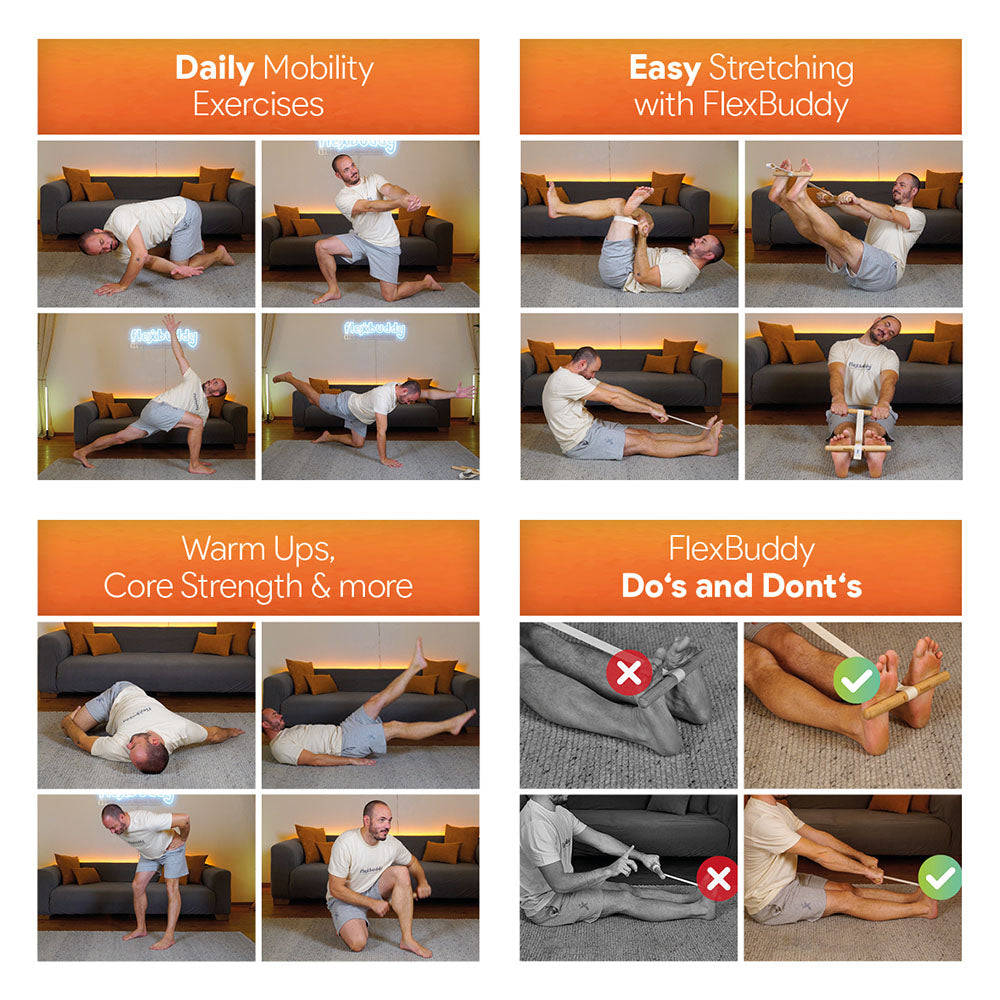
One rule: fold at the hip crease, not at the waist. The back stays long and you stop at the first clear pull behind the thigh. If you feel it in the lower back, you have rounded. FlexBuddy makes this easy: sit on the floor, foot bar under your soles, the other bar in both hands, sit tall, lean back and tilt the hips forward. The strap covers the distance your hamstrings cannot, so the back stays straight. In bed, lie on your back with the foot bar under one sole and raise the leg; the mattress supports your spine, the kindest version for a sore back.
Calves
The calf is two muscles. A straight knee stretches the upper one (gastrocnemius); the seated foot-slide, with the knee bent, reaches the deeper one (soleus). With FlexBuddy, draw the toes towards you and the calf joins the hamstring stretch. The guide to calf stretches shows both.
Hips
The standing version targets the hip flexors, the muscles tied to stride length. Tuck the tailbone under and stand tall; do not arch the back to chase more. The seated ankle-on-knee version reaches the buttock; skip it while recovering from a hip replacement, when crossing the legs is not allowed [24].
Chest and shoulders
In the lying goalpost, gravity does the work; put a pillow under each elbow if the shoulders complain. In the doorway, step through only until the chest pulls. FlexBuddy adds a shoulder opener: stand or sit tall, hold both handles in front with straight arms, raise the device overhead and slightly behind, lower with control, 5 to 8 slow reps.
Upper-back rotation and neck
Turn from the ribs, not by pulling with the arms. Smooth and comfortable is the form of twisting that osteoporosis guidance considers safe [25]. Keep neck movements small and slow, and stop if you feel dizzy.
For ten stretches described step by step, with a strength finish, go to stretching for seniors. To do everything from a chair, use chair stretches; before you get up, stretches in bed.
Flexibility is one of four: aerobic, strength and balance
Stretching works best as part of a team. The World Health Organization asks adults of 65 and over for 150 to 300 minutes of moderate aerobic activity a week (or half that if vigorous), muscle strengthening for all major muscle groups on two or more days, and, on three or more days, varied activity that emphasises balance and strength, to prevent falls [26]. The NHS version: be active every day, work on strength, balance and flexibility on at least two days a week, and break up long periods of sitting [27].
Strength is what makes range usable. A meta-analysis of 11 trials found that strength training improved range of motion about as much as stretching did [28]. So a sit-to-stand that goes all the way down, or a calf raise through its full height, is flexibility work too. Strength is also what age takes fastest [16], and a hip that opens further needs muscle to hold you there.
Flexibility, balance and falls: stretch for a longer stride
At least a third of people over 65 living at home fall each year [10]. Two joints decide how well you walk.
The hip. In a gait laboratory, peak hip extension while walking averaged 20.4 degrees in young adults, 14.3 in healthy older adults and 11.1 in older adults with repeated falls [29]. The ankle. In women aged 64 to 87, ankle range correlated with balance and gait scores [30]. In retirement-village residents followed for a year, those who fell had less ankle flexibility [31].
Stretching moves those numbers. In trials, stretching the hips increased hip extension and step length in older adults [21][32], and a 2025 review of 29 trials found that stretching increased walking speed [33]. For the falls themselves, add balance and functional exercise: the Cochrane review of 108 trials found that it cuts the rate of falls by 24% [10].
Stretch for the stride, and train balance and strength for the falls.
Flexibility over 50 for women: menopause and bones
You start ahead. Women are, on average, more flexible than men in nearly every joint and age group measured [1][4], and in the 2024 meta-analysis they gained more from stretching [8]. Two things are specific after 50.
Menopause, joint stiffness and aches
More than half of women report joint pain around the menopause [34]. The NHS lists muscle aches and joint pains among the symptoms and notes that joint pain can continue afterwards [35]. Exercise is among the measures encouraged [34], and a gentle daily stretch is an easy place to start. A GP can discuss the symptoms themselves.
Osteoporosis: change the stretch, keep stretching
Osteoporosis is most common in older adults and in women after the menopause [36]. The UK consensus statement "Strong, Steady and Straight" found little evidence that physical activity causes harm, and it tells you what to change: avoid postures with a high degree of spinal flexion, and modify or avoid sustained, repeated or end-range forward bending, above all when loaded. It notes reports of spinal fractures after sit-ups and extreme yoga forward bends [25].
In practice, toe touches with a rounded back are out. The Royal Osteoporosis Society teaches the hip hinge instead, bending from the hip with a straight back [37], which is the hamstring stretch in row 1. Twisting is freer than many people think: the statement says rotation should be safe if performed smoothly and comfortably [25], so do not force a twist or twist under load.
Flexibility over 50 for men: hamstrings and hips
Men start from less, so men have the most to win. In adults aged 20 to 79, men's hamstrings were tighter than women's by 8 degrees on the straight-leg raise and 11 degrees on the knee-extension test [4]. In the Canadian over-55 study, men's hip flexion averaged 102 degrees against 114 in women [2]. In the US reference data, men's hip extension fell from 17.4 to 13.5 degrees between the two adult age groups [1].
So the typical pattern is tight hamstrings, tight hip flexors and a toe touch that left decades ago. It comes back. In a trial of adults aged 18 to 46 who stretched for four weeks, men's hamstrings responded just as quickly as women's [38]. A routine for men is the same six rows with more time on rows 1 and 3. Philipp, a blacksmith of 73, on his FlexBuddy: "I never imagined that I would regain my flexibility. But I did!"
Stretching with arthritis
With osteoarthritis the guidance is clear: keep moving. NICE recommends therapeutic exercise for everyone with the condition. It tells clinicians to explain that regular, consistent exercise is beneficial for the joints, and that joint pain may increase at first [39]. The NHS calls exercise one of the most important treatments and notes that not using a joint can increase stiffness. It also warns that too much too quickly, or the wrong sort, may damage joints, so plan it with a GP or physiotherapist [40].
Arthritis UK describes stretching as range-of-movement exercise: bend and straighten each joint as far as is comfortable, until you feel a stretch in the muscles around it, slowly and with control [18]. Its flare rule: when a joint is hot or swollen, keep to gentle range-of-movement work and pause strengthening until it settles [18]. Morning stiffness from osteoarthritis usually eases within 30 minutes; stiffness that lasts longer, a hot swollen joint or rapid worsening is not typical and should be checked [39].
What the range is for: socks, shoes, the floor and the car
This is what the degrees buy you.
- Socks and shoes. Hip flexion and hamstring length with a long back: rows 1 and 3.
- Getting up from the floor. Hips, ankles and leg strength together: rows 2 and 3, plus sit-to-stands. Practise beside a sturdy chair.
- Looking over your shoulder to reverse the car. Neck and upper-back rotation, rows 5 and 6. In drivers over 60, restricted head rotation limited how far away approaching traffic could be seen clearly [12].
- Reaching a high shelf or a back zip. Shoulder range: row 4.
Your timeline at 55, 65 and 75
The pooled evidence finds that age does not predict the gain [8]. Where you start and how regularly you stretch matter more than your birth year.
- At 55. In the first weeks the same range feels milder. That is your nervous system adapting, and it is what programmes of three to eight weeks measure [15]. The toe touch follows over the coming months; how long it takes to get flexible sets out the stages.
- At 65. Women averaging 66 walked with longer steps after 12 supervised sessions in four weeks [32]; women averaging 67 gained 17 degrees of hamstring flexibility in eight weeks [6]. Plan on four to eight weeks for a change you can measure.
- At 75 and beyond. The best-documented group: 2.4 degrees a week for six weeks with 60-second holds at an average age of nearly 85 [5], and 12.3 degrees of ankle range in six weeks at 76 to 91 [7]. Allow six weeks, then keep going.
When to see a doctor or physiotherapist first
- A joint replacement. While recovering from a hip replacement, NHS advice is not to bend the hip beyond 90 degrees, not to cross the legs and not to bend down to touch your feet or ankles [24]. Your surgical team's list overrides anything here.
- Osteoporosis with fractures. With a history of spinal fractures or many broken bones, talk to a doctor or physiotherapist before starting [37]. Back pain that is not improving after a few weeks, or a spine that is becoming curved, should be seen by a GP [36].
- Recent surgery. Ask the team that operated what is allowed, and when.
- Unexplained pain. A hot or swollen joint, pain that wakes you or travels down a leg, numbness, weakness or bladder or bowel changes need a diagnosis, not a stretch.
- Dizziness. If you feel light-headed on standing, the NHS advice is to move slowly from lying to sitting to standing [41]. Tell your GP, and leave the neck movements out until you have been checked.

Make row 1 the easy one with FlexBuddy
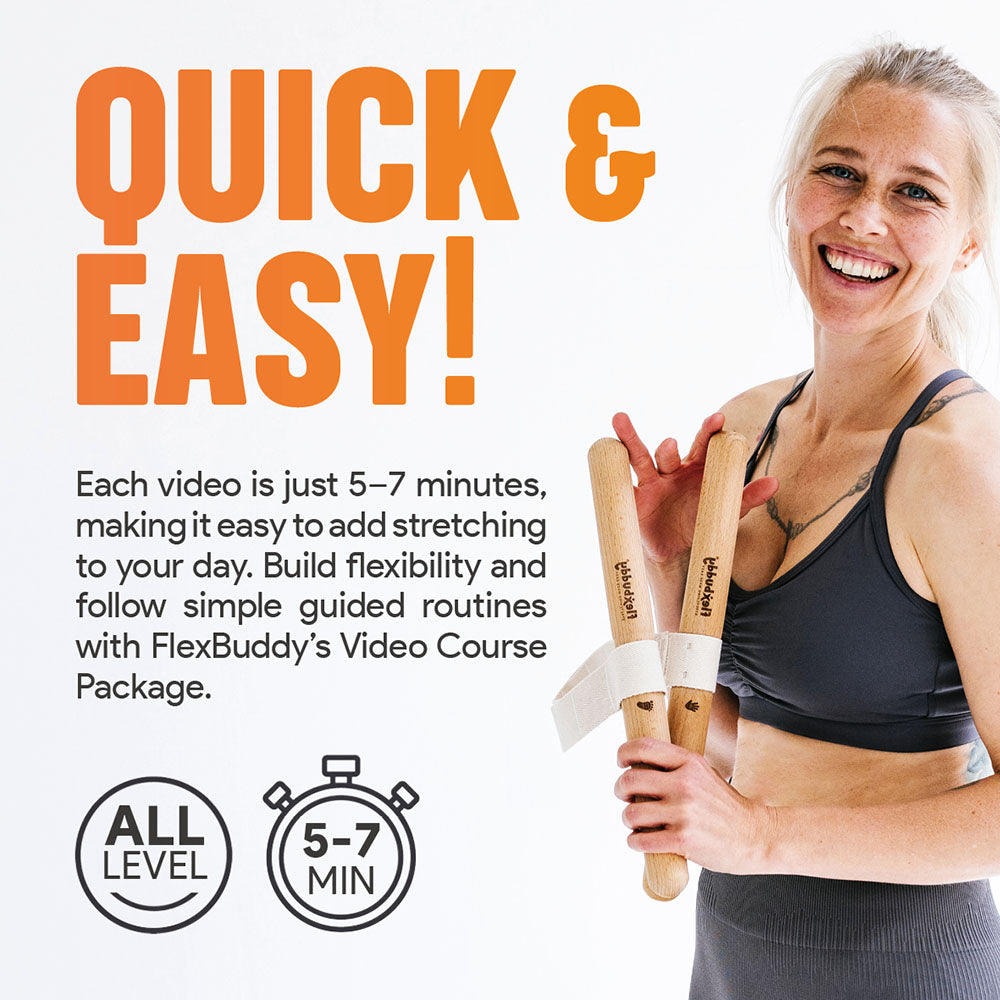
The first row of the routine is the hardest to do well: keeping the spine long while the hands reach for the feet. FlexBuddy® solves that. It is a patented stretching device made of two beech-wood bars joined by an adjustable natural-cotton strap. One bar sits under your soles, the other in both hands, and the strap covers the distance your hamstrings cannot. Sit tall, tilt the hips forward, and the pull lands in the hamstrings and calves while your back stays straight.
Start with the strap long; when the stretch feels mild, roll the hand bar for a small step, or move the foot bar to the next loop for a bigger one. Bob J. wrote: "I am 64 and have never touched my toes. FlexBuddy changed that in a week!" Two minutes a day can improve your flexibility and posture. It is rated 4.5 by verified buyers and comes with a 30-day money-back guarantee and a lifetime warranty, so you can try it without risk. Get your FlexBuddy, or take the two-minute quiz for a routine matched to your stiffness.
Frequently asked questions
Can you regain flexibility after 50?
Yes. Trials in older adults, the oldest aged 97, show gains of 12 to 17 degrees in six to eight weeks [5][6][7], and a 2024 analysis of 77 studies found that age made no difference to the size of the gain [8].
How long does it take to get flexible at 50?
You will feel the stretch getting easier in the first weeks, and you can measure a change within three to eight weeks of near-daily practice [15][5]. Touching your toes follows over the coming months, depending on where you start.
How often should a 60 year old stretch?
Daily if you can, and at least two to three days a week [23][9]. The NHS asks adults over 65 for strength, balance and flexibility work on at least two days a week [27].
What is the best stretching routine for over 50?
One that covers the hamstrings, calves, hips, chest and shoulders, upper back and neck, with holds of 30 to 60 seconds at mild tension and a seated or in-bed option for stiff days [5][9]. Six stretches done this way take 8 to 10 minutes, and FlexBuddy makes the hamstring and calf stretches easy.
Is it too late to become flexible at 60?
No. The best evidence for stretching in later life comes from a trial in which the average age was 84.7 and the oldest participant was 97: 60-second holds gained 2.4 degrees a week [5].
Why am I so stiff after 50?
Usually a mix, and most of it you can change: many hours a day of sitting [17], stiffer connective tissue inside the muscles [13], less strength [16] and only a small real loss of joint range [1][2]. Morning stiffness that lasts more than 30 minutes, or comes with a hot, swollen joint, should be checked by a GP [39].
This article is general information, not medical advice. Tight muscles usually respond well to regular stretching. If your pain is sharp, radiates down a leg, comes with numbness, weakness, fever, bladder or bowel changes, follows an injury, or keeps getting worse, see a doctor or physiotherapist before you stretch.
References
- Soucie JM, Wang C, Forsyth A, Funk S, Denny M, Roach KE, Boone D; Hemophilia Treatment Center Network. Range of motion measurements: reference values and a database for comparison studies. Haemophilia. 2011;17(3):500–507. doi:10.1111/j.1365-2516.2010.02399.x. PMID 21070485. Reference values by age and sex: Centers for Disease Control and Prevention, Normal Joint Range of Motion Study. https://archive.cdc.gov/www_cdc_gov/ncbddd/jointrom/index.html (accessed 10 Nov 2026).
- Stathokostas L, McDonald MW, Little RM, Paterson DH. Flexibility of older adults aged 55–86 years and the influence of physical activity. J Aging Res. 2013;2013:743843. doi:10.1155/2013/743843. PMID 23862064; PMC3703899.
- Roach KE, Miles TP. Normal hip and knee active range of motion: the relationship to age. Phys Ther. 1991;71(9):656–665. doi:10.1093/ptj/71.9.656. PMID 1881956.
- Youdas JW, Krause DA, Hollman JH, Harmsen WS, Laskowski E. The influence of gender and age on hamstring muscle length in healthy adults. J Orthop Sports Phys Ther. 2005;35(4):246–252. doi:10.2519/jospt.2005.35.4.246. PMID 15901126.
- Feland JB, Myrer JW, Schulthies SS, Fellingham GW, Measom GW. The effect of duration of stretching of the hamstring muscle group for increasing range of motion in people aged 65 years or older. Phys Ther. 2001;81(5):1110–1117. doi:10.1093/ptj/81.5.1110. PMID 11319936.
- Gallon D, Rodacki AL, Hernandez SG, et al. The effects of stretching on the flexibility, muscle performance and functionality of institutionalized older women. Braz J Med Biol Res. 2011;44(3):229–235. doi:10.1590/S0100-879X2011007500012. PMID 21399855.
- Johnson E, Bradley B, Witkowski K, et al. Effect of a static calf muscle-tendon unit stretching program on ankle dorsiflexion range of motion of older women. J Geriatr Phys Ther. 2007;30(2):49–52. doi:10.1519/00139143-200708000-00003. PMID 18171487.
- Konrad A, Alizadeh S, Daneshjoo A, et al. Chronic effects of stretching on range of motion with consideration of potential moderating variables: a systematic review with meta-analysis. J Sport Health Sci. 2024;13(2):186–194. doi:10.1016/j.jshs.2023.06.002. PMID 37301370; PMC10980866.
- Page P. Current concepts in muscle stretching for exercise and rehabilitation. Int J Sports Phys Ther. 2012;7(1):109–119. PMC3273886. https://pmc.ncbi.nlm.nih.gov/articles/PMC3273886/ (accessed 10 Nov 2026).
- Sherrington C, Fairhall NJ, Wallbank GK, et al. Exercise for preventing falls in older people living in the community. Cochrane Database Syst Rev. 2019;1(1):CD012424. doi:10.1002/14651858.CD012424.pub2. PMID 30703272; PMC6360922.
- Intolo P, Milosavljevic S, Baxter DG, Carman AB, Pal P, Munn J. The effect of age on lumbar range of motion: a systematic review. Man Ther. 2009;14(6):596–604. doi:10.1016/j.math.2009.08.006. PMID 19729332.
- Isler RB, Parsonson BS, Hansson GJ. Age related effects of restricted head movements on the useful field of view of drivers. Accid Anal Prev. 1997;29(6):793–801. doi:10.1016/S0001-4575(97)00048-1. PMID 9370015.
- Kragstrup TW, Kjaer M, Mackey AL. Structural, biochemical, cellular, and functional changes in skeletal muscle extracellular matrix with aging. Scand J Med Sci Sports. 2011;21(6):749–757. doi:10.1111/j.1600-0838.2011.01377.x. PMID 22092924.
- Svensson RB, Heinemeier KM, Couppé C, Kjaer M, Magnusson SP. Effect of aging and exercise on the tendon. J Appl Physiol (1985). 2016;121(6):1237–1246. doi:10.1152/japplphysiol.00328.2016. PMID 27150831.
- Weppler CH, Magnusson SP. Increasing muscle extensibility: a matter of increasing length or modifying sensation? Phys Ther. 2010;90(3):438–449. doi:10.2522/ptj.20090012. PMID 20075147.
- Mitchell WK, Williams J, Atherton P, Larvin M, Lund J, Narici M. Sarcopenia, dynapenia, and the impact of advancing age on human skeletal muscle size and strength; a quantitative review. Front Physiol. 2012;3:260. doi:10.3389/fphys.2012.00260. PMID 22934016; PMC3429036.
- Harvey JA, Chastin SF, Skelton DA. How sedentary are older people? A systematic review of the amount of sedentary behavior. J Aging Phys Act. 2015;23(3):471–487. doi:10.1123/japa.2014-0164. PMID 25387160.
- Arthritis UK. What type of exercise should I do? https://www.arthritis-uk.org/information-and-support/living-with-arthritis/health-and-wellbeing/exercising-with-arthritis/what-type-of-exercise-should-i-do/ (accessed 10 Nov 2026).
- Hoffmann MD, Colley RC, Doyon CY, Wong SL, Tomkinson GR, Lang JJ. Normative-referenced percentile values for physical fitness among Canadians. Health Rep. 2019;30(10):14–22. doi:10.25318/82-003-x201901000002-eng. PMID 31617933.
- American College of Sports Medicine; Chodzko-Zajko WJ, Proctor DN, Fiatarone Singh MA, et al. Position stand: exercise and physical activity for older adults. Med Sci Sports Exerc. 2009;41(7):1510–1530. doi:10.1249/MSS.0b013e3181a0c95c. PMID 19516148.
- Kerrigan DC, Xenopoulos-Oddsson A, Sullivan MJ, Lelas JJ, Riley PO. Effect of a hip flexor-stretching program on gait in the elderly. Arch Phys Med Rehabil. 2003;84(1):1–6. doi:10.1053/apmr.2003.50056. PMID 12589613.
- Stathokostas L, Little RM, Vandervoort AA, Paterson DH. Flexibility training and functional ability in older adults: a systematic review. J Aging Res. 2012;2012:306818. doi:10.1155/2012/306818. PMID 23209904; PMC3503322.
- Garber CE, Blissmer B, Deschenes MR, et al.; American College of Sports Medicine. Position stand: quantity and quality of exercise for developing and maintaining cardiorespiratory, musculoskeletal, and neuromotor fitness in apparently healthy adults. Med Sci Sports Exerc. 2011;43(7):1334–1359. doi:10.1249/MSS.0b013e318213fefb. PMID 21694556.
- NHS. Recovering from a hip replacement. Last reviewed 6 Mar 2024. https://www.nhs.uk/tests-and-treatments/hip-replacement/recovering-from-a-hip-replacement/ (accessed 10 Nov 2026).
- Brooke-Wavell K, Skelton DA, Barker KL, et al. Strong, steady and straight: UK consensus statement on physical activity and exercise for osteoporosis. Br J Sports Med. 2022;56(15):837–846. doi:10.1136/bjsports-2021-104634. PMID 35577538; PMC9304091.
- Bull FC, Al-Ansari SS, Biddle S, et al. World Health Organization 2020 guidelines on physical activity and sedentary behaviour. Br J Sports Med. 2020;54(24):1451–1462. doi:10.1136/bjsports-2020-102955. PMID 33239350; PMC7719906.
- NHS. Physical activity guidelines for older adults. Last reviewed 15 Aug 2024. https://www.nhs.uk/live-well/exercise/exercise-guidelines/physical-activity-guidelines-older-adults/ (accessed 10 Nov 2026).
- Afonso J, Ramirez-Campillo R, Moscão J, et al. Strength training versus stretching for improving range of motion: a systematic review and meta-analysis. Healthcare (Basel). 2021;9(4):427. doi:10.3390/healthcare9040427. PMID 33917036; PMC8067745.
- Kerrigan DC, Lee LW, Collins JJ, Riley PO, Lipsitz LA. Reduced hip extension during walking: healthy elderly and fallers versus young adults. Arch Phys Med Rehabil. 2001;82(1):26–30. doi:10.1053/apmr.2001.18584. PMID 11239282.
- Mecagni C, Smith JP, Roberts KE, O'Sullivan SB. Balance and ankle range of motion in community-dwelling women aged 64 to 87 years: a correlational study. Phys Ther. 2000;80(10):1004–1011. PMID 11002436.
- Menz HB, Morris ME, Lord SR. Foot and ankle risk factors for falls in older people: a prospective study. J Gerontol A Biol Sci Med Sci. 2006;61(8):866–870. doi:10.1093/gerona/61.8.866. PMID 16912106.
- Cristopoliski F, Barela JA, Leite N, Fowler NE, Rodacki AL. Stretching exercise program improves gait in the elderly. Gerontology. 2009;55(6):614–620. doi:10.1159/000235863. PMID 19713691.
- Salse-Batán J, González-Devesa D, Duñabeitia I, Bidaurrazaga-Letona I, Ayán-Pérez C, Sanchez-Lastra MA. Effects of stretching exercise on walking performance and balance in older adults: a systematic review and meta-analysis. Geriatr Nurs. 2025;61:479–490. doi:10.1016/j.gerinurse.2024.12.018. PMID 39733629.
- Magliano M. Menopausal arthralgia: fact or fiction. Maturitas. 2010;67(1):29–33. doi:10.1016/j.maturitas.2010.04.009. PMID 20537472.
- NHS. Symptoms of menopause and perimenopause. Last reviewed 19 May 2026. https://www.nhs.uk/conditions/menopause/symptoms/ (accessed 10 Nov 2026).
- NHS. Osteoporosis. Last reviewed 29 Oct 2026. https://www.nhs.uk/conditions/osteoporosis/ (accessed 10 Nov 2026).
- Royal Osteoporosis Society. How to exercise safely for bones. Last reviewed 1 Jun 2026. https://theros.org.uk/information-and-support/exercise/how-to-exercise-safely-for-bones/ (accessed 10 Nov 2026).
- Cipriani DJ, Terry ME, Haines MA, Tabibnia AP, Lyssanova O. Effect of stretch frequency and sex on the rate of gain and rate of loss in muscle flexibility during a hamstring-stretching program: a randomized single-blind longitudinal study. J Strength Cond Res. 2012;26(8):2119–2129. doi:10.1519/JSC.0b013e31823b862a. PMID 22027850.
- National Institute for Health and Care Excellence. Osteoarthritis in over 16s: diagnosis and management. NICE guideline NG226. Published 19 Oct 2022. https://www.nice.org.uk/guidance/ng226/chapter/Recommendations (accessed 10 Nov 2026).
- NHS. Osteoarthritis: treatment. Last reviewed 20 Mar 2023. https://www.nhs.uk/conditions/osteoarthritis/treatment/ (accessed 10 Nov 2026).
- NHS. Low blood pressure (hypotension). Last reviewed 11 Jul 2023. https://www.nhs.uk/conditions/low-blood-pressure-hypotension/ (accessed 10 Nov 2026).